Showing posts with label Experimental Theology. Show all posts

Tuesday, September 15, 2015

Testing Theology #3-- Prayer Works

Principle
If you abide in me and my words abide in you, then ask whatever you will and it will be done for you.” John 15:7

“Truly I tell you, whatever you ask for in prayer, believe that you have received it and it will be yours.” Mark 11

Consider it all joy, my brethren, when you encounter various trials... But if any of you lacks wisdom, let him ask of God, who gives to all generously and without reproach, and it will be given to him. (James 1:2, 5)

Theory
Sincere, desperate prayer works. If we are asking out of true need, for ourselves or others who are desperate, then we can be confident that God will hear, give wisdom, and meet our needs.

Test
Although I quit my job in 1997 to work full time for the homeless, and so became homeless myself, Diane and I made the decision that we wouldn’t ask for anything ourselves.  Rather, we would take it up to God and not our supporters and allow God to move the Holy Spirit to encourage people to meet our needs, whatever way God decided.  We lived like this for fifteen years, making God our only advocate, our only financial counselor.

Result
I will admit, living by prayer, we found that we came close to living out on the street, close to losing our water and electricity, close to not having food to eat, close to being without transportation, but none of that actually happened.  Living by faith, we learned, means learning to either live with anxiety or setting aside anxiety.  Because I believe the Holy Spirit works promptly, but people do not respond to the Holy Spirit promptly.

Although the many difficulties of living by faith, especially when it means living in poverty, still my children never lived without a roof, my household (plus many guests) never went hungry, we were able to pay our bills (although rarely on time).  When we had little income, we would have to take our trash to the dump ourselves, we would have to do our electrical and plumbing work ourselves.  When something was broken, if the Lord didn’t provide money, he would provide a person to do the repair for free.  When we couldn’t afford housing, the Lord provided someone to live with, and then he provided someone to pay our rent.  When we had illnesses when we couldn’t afford to go to a doctor (we never had insurance until this year), we prayed and God healed us, or provided other means, such as illegal antibiotics for our children from a Mexican store.

The same with our friends.  God provided housing when a person was too sick to be on the street anymore.  God provided money for our friends when they were starving.  God provided healing for those with ailments.  Every step along the way, if we prayed for it, it would be answered.  Mind you, we are careful about what we pray for.  We don’t pray for anything that someone requests.  We keep our prayers biblical and somewhat humble.  If someone asks that the police would go away, we prayed that the police wouldn’t see them.  Someone might ask for the cursing of someone, and we’d pray for their repentance from action that hurt someone.  Prayer sometimes would take time—it’s rarely an instant solution.  But to the person of faith and compassion, prayer always gets answered. 

Anecdotes
I have many stories I could tell about answered prayer.  There are the many times that we were concerned about someone and we prayed that we would hear from them and we would, within a week, every time.  There are the times when we couldn’t pay our basic bills, and unexpected, unasked for money would come our way—Like the time that we asked specifically for 5000 dollars to pay for all of our back up bills and rent.  Two months later, a congregation member came into an inheritance (early—his father hadn’t died yet), and his tithe to us was 5000 dollars.  But let me tell you a couple specific stories in which prayer was answered in unexpected ways.

We were just starting our ministry and we were living in two different locations, about 45 minutes apart.  We couldn’t live in one space for half the week and we couldn’t live in the other space for the other half of the week.  We were all packed up and ready to drive to the other side of town, with our car in the church parking lot, when the car wouldn’t start.  I can’t fix it because you open up the hood of a car and I am automatically an idiot.  I’m lucky I know where the oil goes.

We were in trouble because we couldn’t stay another night at the church.  And we couldn’t all fit in the car overnight, so we’d be stuck outside, maybe in the park.  My six year old son, Ian, asked me if we could pray that an angel would come to fix our car.  I sputtered, because my disbelief came out.  I told him that I didn’t think God was in the business to send angels to repair cars.  Ian said, “But if you pray for it, it will happen, right?”  His eyes shined with naïve belief.  So I asked him to pray, because I didn’t believe in the prayer, and he responded that he couldn’t pray, I had to.  Sigh.  So I prayed for him, telling God that Ian wanted an angel to come and fix our car. 

It was fifteen minutes later that someone came wandering onto the church property.  He came up and asked if his daughter could play in the playground the church had available.  Ian looked at me as if to say, “This is the angel!”  I sighed again. 

“Um,” I said, “I don’t suppose you know anything about cars, do you?  Because we are stuck here and we don’t know how to get our car started.”

“I know a little bit.  Let me look.”  So I opened up the hood and he piddled for a bit.  After about ten minutes, he turned the key and it ran.

Dang if God didn’t send us an angel.  I hate being wrong, but this is being wrong in the best way.

“I don’t know what I did, actually,” the stranger said.

“Well, my son would be upset if I didn’t say that he made me pray for an angel to fix our car, so you are our angel.”

“HA!” he barked.  “I’m no angel.”

“I’m sure.”

And we drove away, the car expressing no hesitation at the long drive ahead.

* * *

One more story and I’m done for today.
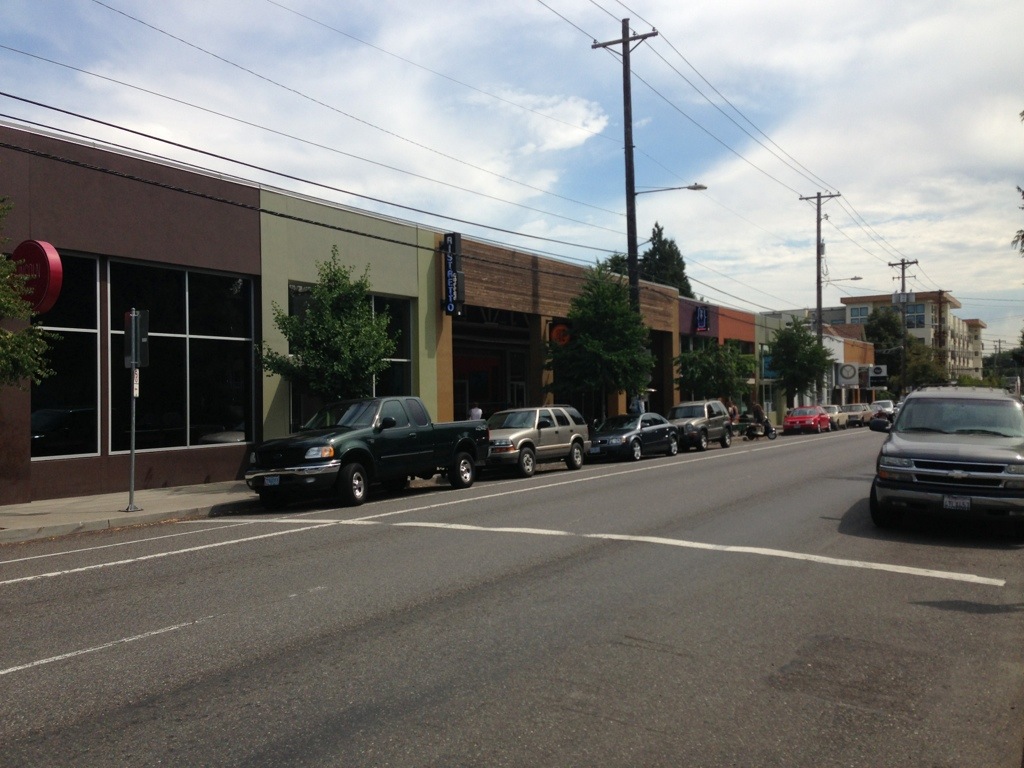
What our street usually looks like.
Our house is on the side you can't see
We were three thousand dollars behind on our bills.  I know, I said that before, but it was a pretty common problem for us, and the more responsibility we took on, the bigger our prayers got.  This was before the five thousand dollar lapse.  So in our evening prayers, we asked the Lord for three thousand dollars to pay our bills, in Jesus’ name, Amen.  And we put it aside, because no amount of worrying would get us that kind of money.

That night, at 1am, my wife woke me up.  “Steve, the car is totaled. You need to come.”  What?  Did she say something about the car?  I stumbled out of bed, went down the stairs and glanced out the door.  The car was not parked in front of our house, where I left it.  That’s strange.  Did it get towed.  Diane is still talking, but I can’t really hear her.

So I go outside and there are police lights flashing in front of our neighbor’s yard.  I see a huge—HUGE—red pickup and the police are talking to a woman in the car.  She is clearly inebriated.  In front of the truck… yards in front of the truck… in front of the neighbor’s house… deep inside the neighbor’s yard… was my car.  The silver minivan was pushed perhaps fifty yards on the street which (miraculously) had no other vehicles on it, and then pushed into my neighbor’s fence and into their yard.  The back was completely smashed in, and one sliding door was completely unusable.  The front of the car was also damaged from impact on the fence.

Inside the car, there were papers and trash strewn everywhere (that was normal) and broken glass and…

I hear an officer ask a question of my wife, who clearly had been speaking to them for a while, “What is that stuff all over the back of the car?”

There wasn’t anything on the outside of the car, oh, he meant the inside.  I tried to open one side door, but it wouldn’t open, so I opened the driver’s door and one sniff told me what was dripping all over the inside of the vehicle.  “Gravy,” I said.  “I feed the homeless and there was a large pot of gravy left over and it was cool tonight so I left it in the vehicle to use it tomorrow.  I guess I won’t be using it.  I would like to get the pot, though.”  Stainless steel 20 inch diameter pot—not even a dent.
I said to my wife, “Well, this won’t help us pay our bills.”

I was quite wrong.  In fact, this was the answer to our prayers.  Insurance paid us immediately because if there was anything that was obvious here, it’s that I wasn’t at fault for the accident.  They paid us 6500 dollars for the totaled vehicle.  We were able to find a decent van to replace it for 3200 dollars.  The balance of the money paid our bills.


I can’t say much for the orthodoxy of God’s belief, but one thing is certain.  God’s answers to prayer are quite unorthodox.

Saturday, March 14, 2015

Giving and Receiving-- Testing Theology #2

Theory: The more you give to the poor, the more you get, in order to give more to the poor. 

Principle:
He who is generous will be blessed, for he gives some of his food to the poor. (Proverbs 22:9)

He who gives to the poor will never want, (Proverbs 28:27)

How blessed is he who considers the helpless; The LORD will deliver him in a day of trouble. (Psalm 41:1)

He who is faithful in a very little thing is faithful also in much; he who is faithful in unrighteous money, will given greater responsibilities. (Luke 16:10)

Test:
In 1995, our family invited the homeless and poor to share of our evening meal.  Some nights we would have one person and some we would have ten sitting outside our two-bedroom apartment.  I was only working part time, and we were barely above the poverty line… and later far below it.  But we always took whatever extra we had and provided for the needy in our area.  We didn’t need to reserve much for ourselves, because we always had our needs provided.

In about a year, as we saw people in desperate need, especially women with children, we would invite them to sleep in our living room.  We learned how to judge who we should have and who we shouldn’t in time, and what we should leave out and what not to (checkbooks, for example). 

Now we have a house, a three acre property, a warehouse full of clothes and furniture and daily donations.  We help feed 450 people a week, house full time 8 people beside ourselves and provide shelter for another 20 people beside.   The more we give away, the more we receive.  As long as we are faithful to give to the poor, and not sell for our own benefit, the more we get to give to more people.

Anecdote:
 Eventually, our apartment had the sick and the freezing staying with us, as well as those who need to be discipled or delivered from their addictions.  Our two bedroom apartment was filled with people, some staying for a day, and some overnight.  Our apartment building was sold to a new owner and he decided he was going to “clean up” the apartment building.  One of the first things he did when he received ownership is provide us with a thirty day notice to evict the apartment.  He said, “Your work doesn’t fit with my work.” 

In the meantime, we had to figure out where we were going to live.  We weren’t going to receive any deposit for our apartment because we hadn’t paid any, for the apartment was in poor condition when we moved in.  And the rent was higher than ever in apartments around town, beyond our means.   We prayed for God to grant us some housing, because we didn’t have the income or resources to get it.
We asked for prayer right after we received the notice from two people: my bishop and my father.  Within two days, my father called me and said that he was willing to purchase us a house.  He didn’t say what he would pay, just that he would purchase us a house.  Amazing!

The question is, what house would meet the needs of our people and our needs and be not too expensive.   We got a realtor and looked on the internet and started to look at houses.   This house was too small, and that house was in the wrong neighborhood.  I felt that God was telling us to look close to downtown Portland, so we started driving in neighborhoods around there.  In one of the poorest sections of North Portland, there was a large house for sale.  Diane said it would be too expensive, but I thought we should check it out. 

The house was used as a foster care home that was being closed down because the family was retiring.  It was also used as a shelter for local homeless folks (and a drug lair for some).  The family who owned it were Christians who helped the poor and seeing that we were the same kind of folks, they were happy to sell it to us.  They gave us a reasonable price and we then had a house with six rooms for people to stay in with our family.  We now have 13 people in our house. 


As we provide for the needy, the Lord provides us more so we can provide for the needy some more.

Saturday, March 7, 2015

Testing Theology #1-- God's Practical Provision

Thesis:
Surrender for God’s purposes allows for our own needs to be met

Jesus’ principle: 
“Seek first His kingdom and His righteousness and all these things (e.g. food and clothes) will be given to you.” 

The idea here is that if we are following God’s calling for us as a family, and if we surrender all we have and do for that calling and for the righteousness that God calls us to, then God will provide all our needs.  Although Jesus mentions only food and clothing, we also, as a family need housing, water and electricity so our children do not get taken away.

Test: 
In 1997 I was led by God to quit my job and to work with the homeless full time.  I asked others, including my wife and my church supporters to pray with me and to seek God’s will in the matter.  All of those involved affirmed this direction and supported us to do this.

 I quit my job in March of 1998.  I asked my parents to purchase plane tickets so Diane and our two kids could stay with her mother in Pennsylvania for four months.  I stayed on a friend’s couch and occasionally slept on the street, all the time eating at various soup kitchens throughout the Portland area, connecting with the homeless.   After four months, Diane and the children moved back and we slept part of the week in a room next to a garage at a friend’s house in Hillsboro part of the week and in an office converted from a house in Gresham  (forty miles away) for three days a week, where we served and counselled the homeless.  The day before we were supposed to leave our room in Hillsboro, a supporter of our ministry granted us enough money for us to rent a two bedroom apartment in Gresham.  The Mennonite denomination also provided us with some funds for living expenses.  During this time, I sold my plasma for some extra finances and Diane went to a gleaner to pick up extra food for us.   We never asked for food stamps or other government assistance.  Eventually, the IRS asked us to apply for Earned Income Credit, which we did, gladly, but we had already been living this way for a number of years.

Result: 
In all this time, to the present day, my children never went hungry, never had to sleep on the street, always had enough medicine to cover their medical needs, always had the clothes they needed and we homeschooled them successfully.  We often had to pray in money to pay our bills, and our bills are often paid late.  Our water was turned off once, and we collected water so the toilets and all worked.  The water company gave us a number of fines and threatened to call child services who would take our children away if they were in a place without running water.  But we were able to pay the bill before it came to that.

After 16 years of living out this experiment of feeding and housing the poor with no salary and no regular income, I can firmly say that God takes care of those who surrender all to serve Him.  God provided for us all these years, especially the early years when resources were very thin.  We still have trouble paying bills and we still live on less than what we can afford.  But in the leanest times, we are provided for and no one in our house has ever gone hungry.

Anecdote:  
We had a household of 12 people, five being my family and the rest being folks who used to be homeless but now live in our house.  One morning we were desperate for food.  There were some condiments and spices, but nothing of substance to eat.   I prayed that morning for God to provide for my children to have something to eat. 

In the midst of my prayer, Diver, who lived in a tent in our backyard, came in and said, “Bye! I’m going out on a bike ride!”  I wanted to ask him to help us get some food, but I decided to trust God and see what would happen.

Diver, meanwhile, got on his bike and trailer and rode South.  After heading that direction for a while, he felt that he was going the wrong way.  He needed to ride North.  “Okay,” he thought and turned around.  Along his ride, he looked in the occasional dumpster, just seeing what he could find.  Usually he’d find quite a bit, especially in apartment dumpsters.  Various odds and ends: CDs, old metal he could scrap, other items of interest.  Today he didn’t find anything.

After riding a number of miles, he came to a Fred Meyers, a local supermarket.  He saw a huge dumpster, the dumpster of his dreams.  He’d never seen it before, so he figured he’d see what he could find.  Climbing the ladder and peering over the side, he noticed that the whole bottom of the dumpster was filled with frozen food.  “Score!” he cries.  As he picks some up, he discovers that all the food is still in the package, and still frozen. 


He fills up his trailer with frozen food and rides back to our house, proud to be able to fill our empty freezers.  That night, and the next two, we ate very well. 

Sunday, March 1, 2015

Experimental Theology

There are different kinds of knowledge, and different ways to determine what is true and what isn’t.  In court, the truth of a past event is determined through witness and evidence.  In science, general truths are determined through repeated experiments and different studies from different cultural spins.  To know a person, we will want to understand their cultural background, interview them and see what repeated actions they do.

How does one determine theological truth?  In the past, traditional stories/poems were passed on to explain how God relates to humanity.  These traditions were eventually written down and then collected in larger texts.  Now, theology is often determined by analyzing themes developed from the collected texts.  The themes are often skewed by the biases and assumptions of those developing themes, because the larger a collection of texts, the easier it is to have at least a portion of the text fit one’s own bias. 

However, I find the truth about God to be extremely personal, based on my own experiences.  The reason for this is because God is a person and my understanding of God has to come from my own personal experiences of him.  I do believe that Jesus, above all other people, had the best understanding of God, and so he leads me in my quest for knowledge about God.  But I don’t just take what Jesus says for granted.  After all, Jesus said some pretty insane things, and I shouldn’t take what he said for granted.  Rather, in my life and in the life of my family, I held experiments to see if certain statements Jesus said was true.   I wish I could say that these statements were true for all people in all situations.  I just don’t know that.  But I do know that certain principles worked for me, because I lived them and saw them happen.  If we had a thousand people do the same experiments in different contexts then perhaps we could make broader claims.  But from where I stand, I can only say that this is how my relationship with God works.

In 1836, George Muller, a missionary to Christian England determined that he would hold a theological experiment.  His theory is that God would provide for all of their needs without asking any human being, as long as they served the poor and asked only God through prayer.  So he established an orphanage in his house, and began to pray for all their needs, keeping a close account of their needs, whether in kind or financial, and also accounting for what they had received by only praying.  This experiment lasted for forty years during which time he built five homes at the cost of 100,000 pounds each, and he received donations worth more than a million pounds.  Not a single child went hungry, nor the workers at his facilities.  His account books were always open to the public and they are still available today.  His theory was proven by his own personal study and sacrifice.

Even so, I have made my own experiments in theology, testing a number of principles of Jesus by living them out in circumstances that one would conclude otherwise.  I can show that these principles worked for me, although not in as great of detail as Mr. Muller.  My experiments I will detail in a number of blog posts with long term effects and anecdotes.

But, in a sense, this is the relationship with God for each one of us.  God works a little different with each one of us, teaching us different principles.  In a sense, in each of our relationships there is a theory, a test and a conclusion.  We think that someone is a certain way, over time we observe and interact and then determine if that person really is the way we thought they were.  The same with God.  We think He’s a certain way and will interact with us a certain way, but in that, time will tell, and we will know only that which we test.   There are many experiments that I have not done, but others have.   And there are theories I have tested and others have not. 


I can’t tell you that God is exactly this way or that and you can’t tell that to me.  All we can say is how God interacted with us, and how he interacted with others.  But hopefully we can encourage each other in our relationship with Him, to take chances with God and step out where we might not do ourselves.