Tuesday, January 20, 2015

Transforming Homelessness


The human brain is created to be infinitely flexible.   If a person loses their sight or hearing, the section of the brain dedicated to that sense is then reused for other purposes.  It takes some time, but any section of the brain can be transformed to a new skill.  Our brain is in a new context and then it re-forms to develop new skills to get used to the new context. While we are developing those skills, we are uncomfortable and scared, but eventually we get used to where we are and we change who we are to adapt to the new context.  This is the reason why humanity is the highest functioning animal.  Not just because we can change our environment, but because we do a dance with our environment, both changing and learning to change until we and our environment are adapted to each other.

A great example of this is the deaf culture of the last hundred and fifty years.  They were given an opportunity to build a deaf community that helps itself, born out of Gallaudet University in Washington DC.  From that community comes a new, complete language—American Sign Language—telephones, lights to answer telephones and a culture that looks and sounds—yes, sounds—different than any culture that had ever existed.  Many, if not most, modern deaf people would prefer to live as a deaf person, in the adaptive deaf culture than to get their hearing back and to try to live in “normal” culture.  They have taken their “disability” and made it a cultural strength, thus increasing the diversity and power of the broader culture, and importing their culture around the world.

Not every person or aspect of culture has this ability to adapt and change.  Most of us have certain abilities and so we are insisted upon to fit into the normative culture as it exists.  Since most people have the ability to adapt to things as they are, they do.  But not everyone has that opportunity.  For instance, the homeless.

The chronic homeless are a people who have all been de-normalized.  They’ve been told, individually, that they do not belong in “normal” society and that they must live apart.  They are denied a social network that can support them to fit into normal society.  Those who have lived on the street for a year or more have not only been without a home, but they have been denied opportunities to come back into the fold of normative culture.  And so they adapt to their new environment, and they form a new culture, based on their need to survive.

In their new context, they are taught that they are disgusting and shameful.  They learn this by the fear and anger that some people approach them with.  They learn this by their interactions with police officers, which has increased tremendously since they became homeless.  They learn this because of the fear they experience when they sleep—fear of being seen, fear of being woken, fear of being beaten in the middle of the night by strangers.   They learn that they are vulnerable people, partly because their sleeping gear and personal items are often stolen, but also because they now can receive things for free from generous people, both homeless and non-homeless.   They learn their helplessness because people offer them food for free. 

They also learn that they are criminals.  They learn this through police interactions, who basically treat them as criminals, or at least suspects of wrong-doing.  Because they are treated like criminals, they realize that they can act like criminals because they are already suffering the consequences of criminal activity.  So, clumsily, they learn some criminal activity.  But they don’t really put their heart into it, because they know, in their heart, they aren’t a criminal.  They are just someone who is trying to survive.  They will try using and abusing drugs and alcohol because it helps them to not care about the shame and blame that they are saddled with.  

But these long-term homeless folks still have the amazing brains that are adaptive.  They just are using them to survive in their new environment.  They aren’t useless or helpless, no matter how often people put them in that box.  But since they are expected to be both useless and helpless, they learn to adapt to that environment.

But what if that environment changed?  What if they were given opportunities to help themselves?  Then the homeless adapt toward that.  On a church property in Gresham, a small group of homeless have a place to sleep and cook and they take care of their own environment, all on a volunteer basis.  In Portland, a community builds its own homes and lives independently, with small help from their compassionate surrounding neighborhood.  Perhaps homelessness isn’t easy to adapt back to be “normal”.  But it can be adapted in order to be self-sustaining and in cooperation with the surrounding, normative communities.

The poorest communities in the world have escaped poverty.  It happens every day, all over the world.  It doesn’t happen because a large organization steps in and gives the people what they need.  It is because they develop within themselves adaptive communities that help themselves. 

It usually goes like this: a representative of a development organization steps into an impoverished community, and organizes a meeting with the community leaders and other interested parties.  The representative says that his organization wants to help them create a project to be a more sustainable community, but the community itself must decide what this project will be and they must determine how it would be done.  Over time, through discussions, arguments and anger, a decision is made by the community as a whole on one project.  The organization provides some seed money and some expertise to develop that project, and with money and labor by the community, the project is finished, and the community is improved.  Then the community moves onto the next project.

The development organization doesn’t come with their own agenda apart from one: creating a community that creates their own solutions and implements them.  They don’t have an idea of how the community should live, or what the solutions are, or how to create a better community.  They just provide the impetus and opportunity to create a greater level of sustenance.

This can work for the homeless.  It has been done through Right to Dream 2, and other sustainable communities.  It cannot be done without struggle and without sacrifice, because our society has determined that the chronic homeless are blameworthy, helpless and useless.  But the homeless themselves can change those false expectations, if they but given empowerment and encouragement.  The homeless have already proven that they are adaptive and community-oriented.  They just need to be given the opportunity to make their own changes,  to be given the opportunity of location and some seed money, to make their own changes.

As long as society is telling the chronic homeless who they are and how they should survive, the homeless will never make steps forward, for society is big on creating demands, but not opportunities.  The homeless need to be given the location, time and resources to make their own changes.   We will not see homelessness end, but we will see it transformed into a creative, adaptive culture that is still separate from but fits within normative culture. 

Thursday, January 15, 2015

Two Stories about Mercy

The other evening a woman gets off of the MAX at 162nd and walks the street to her work. A gang corners her and demands his money. She didn't have any, so they beat her up and left her on the street, rifled through her purse, found out she wasn't lying and left her there, bleeding. 
A Baptist pastor whose church was down the street drove by, but he had a board meeting to go to, so he couldn't stop. A staff person for an important local homeless ministry happened to be going by, saw the woman, wanted to stop, but he had an important donor to meet, so he kept going. 
A Muslim man, dressed in a white cap was just walking by after prayer, saw the woman and immediately called 911, check her pulse, took off his cap and pressed it to the wound, speaking kind words to the woman until the ambulance arrived.
So which of the three displayed the mercy of God?

* * *

The unworthy nations of this world will be subjected to the king of mercy and power. At that point, every person in the world will be taken before the king, and they will be divided from one another: one side to his right and another to his left.
The king will look to his right and tell them, "I welcome you into my kingdom, for you are the kind of people I want to live with, that I want to fill the world with. For I was oppressed and downbeaten and starving and hopeless and avoided and you went out of your way to help me, to support me and to encourage me. Please, let me live with you forever."
And those on his right will say, "When did we do this? Many of us aren't Christians and others didn't go to the right churches?" His reply: "This day is based not on who you say you are, but on what you did. You had compassion on my family, and so you had mercy on me. Please, come in and receive the world."
The king will then turn to those on his left and say, "I cannot have you in my kingdom. You shall spend the rest of your days miserable because you will be living with people just like you. For I was homeless and oppressed and starving and suffering with my children and you laughed at me. You told your spouse that I wasn't worthy of being helped. You were rude to me in my suffering. You ignored me when I was at my wits end. You politely told me that you couldn't help me when the reality is you wouldn't help me. You are the people I would never have in my world, because you tear the hurting down instead of building them up. I exile you."
And they will reply, "But Lord, we worshiped you in our churches. We built you great buildings in your honor. We created communities in your name. We preached to thousands. We led Bible studies and prayer meetings. We got rid of those who were unholy from your people. We made the world safer through our military and police force. We loved, but in our own way. Isn't that enough?"
He said, "Since you did not love the vulnerable, but harmed them, you are not the citizens I can have in my kingdom. See if you can live with each other. You are exiled."

Thursday, January 8, 2015

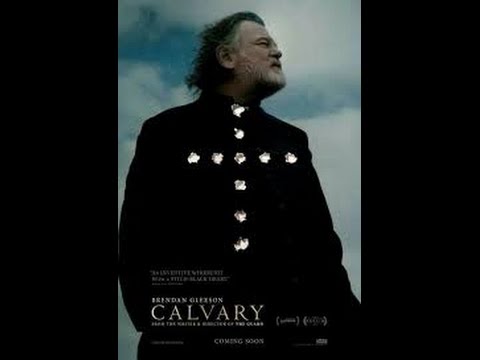
Calvary, A Sociology of the Good Person: MennoMovieNerd

You would think that being a good person is just pats on the back and accolades.  Rather, the cliche is too often true: "No good deed goes unpunished."

Goodness isn't the same as just being responsible.  Anyone can support their family, be a good provider. Goodness is that extra step of self-sacrifice.  It is being the parent who is gentle with the teenager when she is screaming at your face.  It is the neighbor who doesn't complain about the next door mess, but comes over to help them clean it.

Certain people are given the social position of being a mini-saint: teachers, social workers, medical workers, religious leaders. They have an additional responsibility of goodness.  They are given the task to not only work for their family or themselves, but their whole community.  They are not allowed to slip up, to say that which is inappropriate, to bend or break community standards.  They cannot scream at their objects of help, they cannot take advantage of them, or else they will rightly be accused of harming the vulnerable.  They are held to a higher standard.

Normal people compromise their standards.  That is seen as being human.  They will give up, be prejudiced, even hate, and that is fine.  They understand that being human is weak, that everyone breaks at times.  But the good person may never break, never give up.  They must always be strong in goodness, always put on a good face.  Unfortunately, this means that every good person is an implied accusation to those who get drunk, who give into their hatred, who refuse to forgive, who allow life to break them.  The good person is an offense to those who are normal.  Thus, the normal person must constantly buffer the good, to force them to display their humanity, to show that they aren't any better than anyone else.

The good are threatened, they are called names, they are accused of that which they did not do, they are given motives that they never thought of, their children are threatened, they are beaten, they have fists in their face, they are screamed at, they are hated.  They are tempted with sex, with drugs. This happens to them so they will break and show hate and prove their weakness, and so prove their humanity.

Of course, the good are human.  Every human has a certain level of will power.  Some have more and some have less.  Will can be exercised, like a muscle and it can also atrophy or be overworked and strained.  But no matter who we are, we only have so much will power to work with in our lives.  We focus our will on certain things, which means we don't have will to put into other aspects of our lives.  A surgeon might spend so much focus on precision in cutting and creativity in repairing the human body, that they might not have energy to put into being polite to their patients.   A mother may spend so much time and energy on her toddler that she doesn't have enough "get up and go" to clean the house.  We may disagree as to how a person spends their limited will and energy, but we must admit that no one can do everything.  This is why the normal person is compromised.

What is rarely known is that the good person is also limited.  It is just that they focus their will on being good to others, in being compassionate, in assisting the vulnerable.  This means that other aspects of their lives are reduced.  The priest won't spend time on fixing up his room, the pastor may not spend time with his family, the compassionate person may be addicted to pornography, the teacher uses much of the summer break recuperating from the rest of the year.

And, of course, the good person may very well break.  They might get tired of the accusations and strike back.  They might neglect their family or have an affair.  They might give way to a stroke. They might fall into severe depression or other mental illness.  They might become a hermit or become self-focused.

But what happens if a good person doesn't have any severe breaks?  What if they just move to a different community?  Or, God forbid, suddenly die?  It is then that they really become a saint to the community.  A saint is only safe after they are no longer available to be an accusation.  They can be lauded and statues can be made for them and they can be safely regarded as a community hero.  People might even change after they are gone, seeing their strength and goodness as an example.  Their struggles and difficulties are seen as a passion, a legend of their goodness.

The only loved saint is the one who is no longer there.

Sunday, January 4, 2015

Why I Love Movies: MennoMovieNerd

Michael is spending the afterlife in this theatre.
Must be the popcorn. 
Movies are central to my life.  On average, I participate in about two hours of movie-watching daily.  That’s more than seven hundred hours a year.  If I keep this pace up I might chalk up perhaps 35,000 hours in my adult life. Some would say that as a pastor, or a Christian, movies shouldn’t take such a large part of my existence.  I should spend that time in prayer, perhaps or Bible reading.  I don’t know, perhaps I should.  But I spend my life living with and working with people who deal with tragedy on an everyday basis, so I figure I’m deserved a break at times. 

I have a friend of mine who looks at my bookshelf every once in a while and aloud wonders at the large amount of fiction books, as if there is a problem with good Christians reading fiction.  Some people have the same idea about movies, as if they are a “waste of time” and unworthy of a productive life.  Well, I lead what I consider to be a pretty productive life, and movies play their part in that.  Below are some reasons why. 

I think that my wife might exchange the word “books” for my word “movies”.  And I think that any form of art might be able to take the place of movies in my life, if they were as integral.  So feel free to  put “music” “fiction” “poetry” “art” or whatever else connects to you in place of my focus on movies.   Just one other thing: I’ll be speaking specifically about watching DVDs at home, because I rarely get out to the theatre.

Tell your boyfriend goodbye!
Because I need a break from life
I’m a busy guy.  I know this because everyone tells me I am.  And I know this because after a day of working, I am exhausted, ready to collapse.  As an introvert, I need to take a break from people and their demands, just to recharge.  Watching a film allows me to be passive while my mind is active.  It allows me to interact with two-dimensional beings on my own terms.  I can decide if they will make me laugh or sad.  I can decide if I’ve had enough of them and just need a break for a moment.  I can turn down the volume if they are too loud, and freeze them if I need to use the restroom or get something to eat.  For a few moments, I’m in control of my surroundings. 

This may make me sound like a power-hungry control freak.  But it is because I feel so out of control for most of my life that I feel I need an arena in which I can control.  People think I am in charge of a lot, but actually I see a reality that is best for others, and strive to reach that reality.  I live most of my life trying to meet people’s needs and to meet their expectations.  When it’s just me and a movie, then I can meet my own needs for a bit, and these two dimensional beings act for my benefit.  This doesn’t mean they always do what I want, not at all.  And that’s part of the joyful surprise.

Kubrick, to what horror-filled place did you send me?
Because I want to expand my experiences
In 1983, before Christopher Walken was only playing scary guys, he starred in a B-grade sci-fi called Brainstorm.  The idea of the film was a technology was developed in which one can “videotape” experiences, tapping one’s experience in the mind and placing that full experience into another person’s brain.  Someone could learn piano this way, or experience a roller coaster or re-live someone else’s tragedy. 

To a lesser degree, this is what movies are like.  Saving Private Ryan, in the twenty minute D-Day scene, gave non-combatants a sense of what the constant danger of a battle means.   Ordet allows us a glimpse of what the disciples experienced of Jesus’ passion (more so than the over-brutal Passion of the Christ).  Amadeus helps us view Mozart’s music through one who truly loves and hates it.  At times movies give us an opportunity to empathize with those we might never want to, like The Godfather or Citizen Kane, but we obtain a new perspective on humanity as a whole by experiencing these lives.

A life with art expands our experiences to accomplish what we will never do ourselves.  Art can help us climb Everest, can walk us through Dante’s Inferno, can help us empathize with an evildoer and can give us a sense of being a saint.   Without art, we will be limited to just who we are, without being anyone else, which leaves us poorer human beings.

Because I need an outlet for my emotions
My job pretty much is that of a social worker.  I listen to stories of tragedy all day long and my task is to solve problems, erase difficulties, point toward solutions.  All too often I hear the worst of tales and there is nothing I can do… nothing anyone can do.  Yet it is my role to remain stoic, to be calm and not to worsen their own fate by causing it to be more dramatic than they can handle.  I am level-headed, looking for help.  I make sure they know I take their problems seriously, but I am a solver, not an emoter.  Meanwhile, I pack this tragedy into my heart, stuffing it with the hundreds, thousands of stories that I have heard.  They are all packed in there so tightly, that they are in danger of bursting out, often in frustration or anger.  Frustration that there is nothing to be done.  Anger because I feel overburdened with tragedy, not a single one of my making.

I know of a mental health organization where each social worker is required to see a therapist monthly, to process the stories they obtain from their clients.  That’s a great idea, but not everyone can afford this, or have employers who can afford this.  My therapy is film.  Occasionally, the right time and the right film meet and I am able to release my pent-up emotions.  I wept watching Wendy and Lucy, tears streamed down my fact at Joyeux Noel, and I openly sobbed at the musical of Les Miserables.  I didn’t used to cry at films, but now I look for the opportunity.  Life for many is tragic, and we all need an opportunity to let it go.

Of course, some ideas are better to never have heard...
Because I want to learn new ideas
Along with expanding my experiential horizon, movies can help me do what I most enjoy: explore new concepts.  I am a concept junkie.  I love seeing things from a new perspective, opening up doors in my brain that I have never explored before.  Books like Thinking Fast and Slow are like a whole bundle of Christmas presents, each chapter exploring a new, shiny bauble for me to play with and examine. 

Even so, certain films open up my mind to ideas never realized.  The Mission (1986) introduced pacifism and fighting for justice from a Christian perspective to me.  The idea of mercy as being the foundation of the universe is explored by Tree of Life.  The idea of growth through discipline and adversity is explored by Groundhog Day.  Many of my favorite films not only give me compelling characters and entertain me, but also create new thoughts, which I can use later in my life.

Jack and I are feelin' good
Because I need an emotional uplift
I am of a melancholic nature.  I’m more comfortable with the sad story than the happy one.  I expect life to be unhappy, and thus far life hasn’t disappointed me.  But I can get to an emotional state in which I am no longer able to play well with others.  I can be moody, withdrawn or sullen.  It used to be when I got in that kind of mood, I would bask in depressing music and wallow in my dark mood. 

This doesn’t work so well for a marriage, I found.  My wife never understood my dark moods, and my children just simply ignored them, running over them roughshod.  As my responsibilities grew, I found that I wasn’t allowed the luxury of melancholia.  So I sought an out, and movies and television provided me an opportunity.

If I need a cheerful (but sarcastic) disposition, then I can watch a couple episodes of Gilmore Girls and I laugh myself into a better mood.  If I need a burst of energy, I can watch Die Hard or a Star Wars film.  If I need to be productive and fast-paced, an episode or two of West Wing does the trick.  Film provides a mood changer, providing both a setting and characters for me to conform to.

There's a limit to how deep I want my experiences to go
Because I want to learn about modern cultures most powerful art form
The world is a complex place.  It always was, and always will be.  Art gives us an opportunity to explore the vastness of the world and of the universe, both in its reality and its possibilities.  The worst of art only tells us what we already know, enforcing our preconceptions.  The best of art opens up old worlds that we never knew existed, and new minds that sees the world in a way we could never perceive without art. 

Film is not the newest art form but, along with novels, it is the deepest experience.   When watching Gravity, we might experience floating in space.  When watching Rabbit Proof Fence, we not only learn about a period of history we might not know about, but from a perspective that we would never read about outside of fiction.  Through film we can be surrounded by a world, step into it and observe it, feel it and know what it means to be a character in that world. 

Someday perhaps a virtual reality might give us that kind of experience.  But right now, in this era, it is the time of movies.  In a matter of an hour and a half, we can live a life we have never dreamed of in an area of the world we may have never thought of before.  Yes, often we are simply riding the rails inside of a couple artists’ minds, but when we have a remarkable artist, isn’t it worth it? 

Because of movies, I find that I am a richer, more complex person.  I am more stable and (if I don’t keep talking about movies all the time) more interesting.  Movies take the ins and outs of my everyday experience and allows me to see the sparkle in the humdrum, the significance of the mundane.  I laugh at what others do not see and understand the sorrow that no one sees.


That’s what’s so great about film. 

Saturday, January 3, 2015

New Year's Prayer

Father, 
may this year be full of 
chaos and 
scandals 
that will bring benefit to 
the poor and outcast. 
May we live in interesting times 
that bring mercy 
and justice 
to those who need it most. 
In Jesus' name, 
amen.

Sunday, December 14, 2014

"With Great Power Comes Great Responsibility": Our Demand for the Superhero Fantasy

Yes, this post is my Spider-Man post.   I am Menno.  I am Nerd.  Hear me roar.

I have often wondered about the popularity of superheroes.   I understand that they are the new versions of mythology, gods come to effect the earth.  But there are fundamental differences between the ancient myths and modern comic book stories.  First, the ancient myths were about the foundations of everyday life, whether talking about the creation of the world or the development of music, or government structures.   Superhero stories are about people working within the structure of a world we already have.  As time goes on, comic books became more about people who are fundamentally humans with unique gifts. 

Second, superheroes relate to humanity on an everyday, normal basis, many holding down jobs and “secret identities” so they don’t become separate from humanity.  The gods purposed to be separate, only mixing it up when  they had particular lusts, jealousies or angers to take out on their lesser  creations.  Superheroes are human first (even when alien) and super second.

The ancient world had one hero who was most like a superhero and that’s Heracles.  He had a wife and children and interacted with kings, with his home being earth not Olympus.  But he was also a raging maniac, killing his wife and children and fundamentally uncaring about other people, at least less so than his own emotional state.  If Heracles appeared in modern comic books, he’d be a super villain, if perhaps a sympathetic one.

So if the ancient myths and superheroes fulfill different purposes, then why do we have them?  Why are they the most popular form of pulp fiction today?  

I think it has to do with a loss of innocence on our part.  The rise of the superhero can be tracked along with the rise of the police procedural.  All throughout history there are stories about corrupt authority, beginning with the myths and Gilgamesh and the Bible all the way to current myths like V for Vendetta and 1984. Authority has always been seen as this mix between noble duty and selfish interest for those who wield power.  

World War I showed us just how corrupt and destructive authority could be.  In the years between the world wars, there is an ideal of authority presented—how they are working for peace, and those who follow the law are those who have nothing to fear from the law.  World War II in popular culture showed that authority’s primary aim is to save us from evil forces that want to destroy our way of live and our families.   Every superhero created between the wars, got behind the war effort in WWII and some, like Captain America, were created specifically to battle the Nazis, in the guise of super villains like the Red Skull.

In the 60s, the place and motivation of authority was widely questioned, so it was time for heroes like Spider-Man and the X-men.  Those who had power and authority and used it for the good of humanity, despite the fact that authorities distrusted them and tried to capture them.   It was time for the Silver Surfer, who rebelled against his authority/god, using his lesser powers to assist humanity.  It was time for the Hulk, whose power was, at best, a two-edged sword, which could cause equal amounts of benefit and destruction and was simply a ticking time bomb.

Superheroes are ultimately stories about the use of power and authority.  They represent the ideal of what we want our authorities to do.  Superheroes are incorruptible, they have principles of justice which cannot be assailed.   Superheroes act for the benefit of all people, all the time, having the greatest powers of violence, but only use them for peace.  Superheroes have the principle that they will not kill, even the evil, believing that justice is best served by procedure and not by quick judgments.

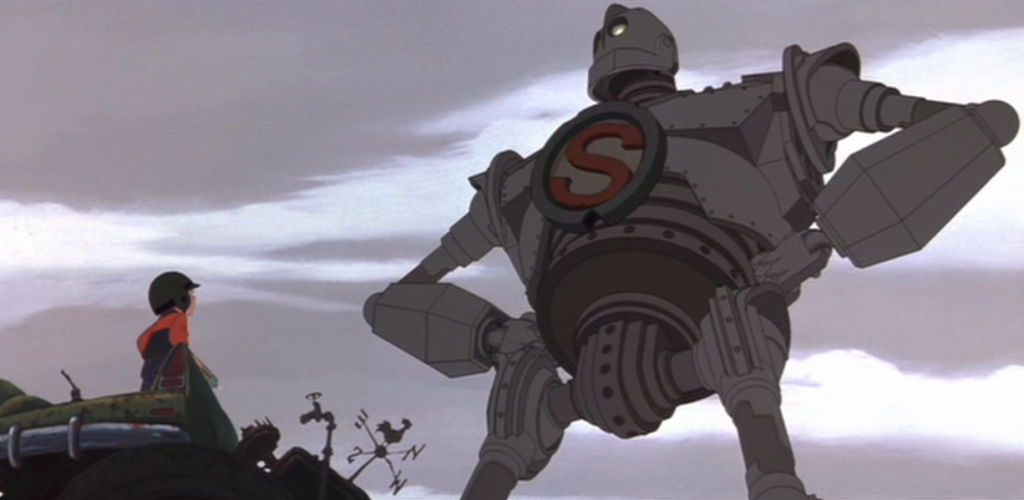
Superhero comic book stories are our fantasy of how power and authority should be used.  We want our police forces and military forces and politicians to have a moment of awareness, like the Iron Giant, who chooses to be Superman instead of a gun.  To choose to use one’s power to save humanity and not to destroy.

Today,  we are re-examining our authority structures and realizing that they are not all their propaganda say they are.  Well, we already knew that, but we used to be able to live with it, looking at the long term progress and ignoring the short term injustices. 

But we are beginning to see, as a nation, that we no longer accept simply guns in our neighborhood, making violent decisions for a self-righteous few.  We want Superman.

We want authorities with power who will use that power for the benefit of all, not just a few.  We are tired of corrupt politicians.  We are tired of a military that works for the benefit of corporations.  We are tired of police forces that attack the vulnerable, simply because they can.  We are living in an existence in which our Superman is under the thumb of Lex Luther.  We want Superman to live according to principles of peace and justice and love. 

The only way to have authorities live out our superhero fantasies is to make them subject to principles of justice and love, and that requires real accountability.   If a politician is corrupt and self-serving, not living according the principles of public  benefit, they should be immediately dismissed.  If a military force kills the innocent, they should be held accountable and dismissed if they fail to see that human life is the basis for human morality.  If a police officer abuses their authority, harming or killing the vulnerable when they had other options, they should no longer be allowed to be an authority.  Because ultimately, we all understand the principle of “With great power comes great responsibility.”

If we are driving a car, we have greater responsibilities and accountability than if we are walking down a street.  We are all human, we all make mistakes.  But if our freedom to drive a two ton vehicle causes the death of another because of our human carelessness, then it is called manslaughter and we are punished for that.  If it is found that we are excessively careless with pushing a car’s weight around, like driving while intoxicated, then our right to drive is taken away.

Even so, those who have authority in our culture have greater weight, greater power than the normal citizen has, and so must be held to a higher accountability.  If a person wants to carry a gun, they should go through training and safety precautions like we do with a car. If, in use of one’s right to carry a gun, a person kills, they should be held accountable for that.  If a person has political authority and uses it to destroy a community, they should be taken out of office immediately.  If a person has the authorized use of force to provide security and they use that force to harm those not processed by justice, then they should be immediately dismissed. 


Don’t tell me that people deserved death when there is no evidence.  Rather, those who have the greater power have the greater responsibility or they must lose their power.  Uncle Ben was right.  As usual. 

Tuesday, December 9, 2014

Driven by Fear

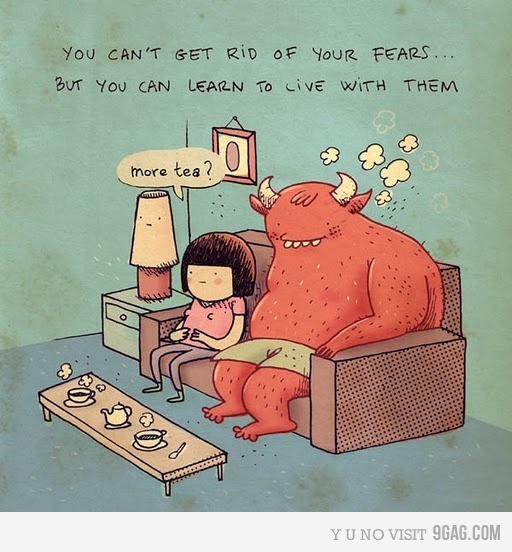
There are certain fears that we should respect.  Fear of cliffs.  Fear of snapping dogs.  Fear of a person who is threatening to kill us.   But when we fear whole groups of people—Blacks, Muslims, the homeless—then we no longer have a proper fear, but rather anxiety.  We are fearful of that which we do not know will harm us. 

Our most natural responses to fear is to either fight or run.  But they are not the only responses possible for human beings.  We might also discuss or argue, threaten or remain passive, we might listen and understand, we might control or establish peace.  When we are authorities, we have even more options than others to that which we fear.  We can order, we can encourage, we can bring in others to help us, we can meet needs. 

I can’t tell people what to fear or not fear.  I can’t tell people what they should be anxious about or not.  But I do know from my own experience that I can control my fear and choose to be rational.  

When I was a child I was attacked by a dog in front of my house.  Since then, barking dogs set an immediate fear response in me.  I can’t control the shot of fear that goes through my brain, but I can recognize in the second moment whether the dog is really a threat or not, and whether someone is handling their dog appropriately.   One time I was out on a trail and an unleased dog was barking at me.  I was wildly afraid of that dog, and the owners telling me that the dog was nice did nothing to ease my mind because the dog clearly did not like me.  I had options.  I could have kicked the dog.  I could have yelled at the owners for their irresponsibility.  I could have decided never to go out on that trail again.  What I chose to do is to firmly ask the owners to keep their dog away from me, and to remind them that the dog should be on a leash.

If a dog is on my property and getting out of control, I have more options.  I could say that no dogs are allowed on the property; I could just ignore the dogs and let them do what they want; or I can get with dog owners and establish a policy that works for everyone.  Because that last was the peaceful solution, allowing ministry to be done for everyone, that’s what we did.  We want to choose options that are best for everyone, despite our fears or anxieties.

As followers of Jesus, we should not allow our fears or anxieties control us.  Rather, by the direction and power of the Holy Spirit, we should set aside our fears in order to live with everyone in love and peace.  If we are directed by our fears, it will spell disaster for everyone.

Yesterday, I was in a crowded parking lot.  An older lady was having trouble making a left turn and ended up having to back up and start again.  Another lady was waiting for her to move, and when she saw the first lady back up, she became nervous and backed her car up as well, even though the first lady wasn’t going to get close to her vehicle.  That’s no problem, of course, being overly cautious and taking care to avoid an accident that wasn’t going to happen, right?  Well, it would have been fine, except that there was a group of three children walking behind the second vehicle, and the second lady was fearful enough of what was happening in front of her, that she didn’t notice the children that she was running into.

When we have power, like a car, we might think of ourselves as a weak, frail human being, but every movement we make affects others.  If we are careless, or respond out of our own deep need or fears, we can harm the weak and the innocent.   When we have power, every move we make is powerful.  And if we use our power in response to fear, rather than a drive to act in peace for everyone around us, then we will be destroyers of peace, and destroyers of lives.


When we use power, we must seek the benefit of all, not just a few.  And if we use power primarily for our own survival, or lifestyle or in response to our fears, then we can cause destruction to many.  It doesn’t matter if that power is money or weapons or authority.  We have a responsibility to everyone around us, especially those weaker than us, to use our power for peace, not our personal protection.