Religion is the arena of popular, especially traditional, philosophy and ethics. Courtroom dramas push the envelope of ethics, displaying where law fails ethics, or the law can uphold ethics, depending on the story. Gett is the intersection of traditional and modern ethics in the midst of a curious courtroom drama.
The set up sounds like the Iranian drama from a couple years ago, A Separation, in which a woman desires a divorce from her husband, but obtaining that divorce isn’t at all clear cut. In Gett (which is the Hebrew term for “divorce”) it is clear that the husband is a righteous man, a scholar of Torah, who neither abuses nor cheats on his wife, and although it is clear that their marriage is far from a happy one, he refuses to give her a divorce. And he has the right to refuse her.
In a secular court, divorce, especially since the 1950’s, has been much easier to get. The trickiest part is if money or children are involved. In a religious court, such as Orthodox Jews or Catholics might have, a divorce is much more restrictive, and a level of unfaithfulness must be proven. Of course, one could always obtain a divorce through the secular court, but not if you want to remarry a Catholic or an Orthodox Jew. Then the right to remarry a religious must be obtained through religious permission. Vivian Amsalem is a religious woman, and wants to live her life at peace with a religious man. Thus, she must have a gett.
The ethical principle primarily being challenged in this film is patriarchy. Ancient Jewish culture is the oldest patriarchy based on a rule of law that considers all in the society, still in existence. Many Jewish cultures have set aside patriarchy, but many have not. Certainly, a strict reading of ancient Jewish law says that a divorce may only be obtained if the husband hands a written divorce to his wife. Thus, the husband has all the control of a divorce. A woman might sue for divorce, like Vivian, but she does not have the right to speak for herself, and if the husband refuses to give a divorce, then the judge’s hands are tied.
As a narrative, the great mystery is the marriage itself. All we see is the speech offered in court and in the anteroom. We have no idea how they lived or why Viviane is so desperate to get a divorce. And the courtroom proceedings, for the most part, carefully steps around the marriage, speaking of reputation and the public face of the marriage, only giving us small glimpses of the marriage itself. So we, along with the judges, are piecing together the truth and the motivations behind Viviane’s desperation and Elisha’s refusal.
While the hesitantly granted details are interesting, what is really on trial is the process itself. The greatest benefit of modern justice, in the instances when it is allowed, is the ability to speak one’s own perspective. An older male can never understand what it means to live as a woman. A wealthy person will never really appreciate the difficulties of being poor. The sane will never understand the way a mentally ill person undermines themselves without knowing. The white person won’t understand the limitations of being a black American. We can intellectualize the situations, even appreciate the difficulties, but the life of an oppressed person is much more difficult than any of us realize until we have experienced it ourselves. The life of a person of power is all the same, but each life of oppression is uniquely different. Thus, the oppressed must have the opportunity to speak, to explain, to give windows to the difficulties. And if there is a system in which the weak are not allowed to speak their peace, then no one can say it for them. No one will give them justice, because no one other than they even know what justice looks like for them.
Everyone must be given an opportunity to speak for themselves, to explain who they are and the difficulties they face. And people of power must be forced to listen to them or else justice will be thrown out the window.
The film is sparsely decorated, simply scripted, but the cinematography is interesting. Each scene is uniquely set up, with cameras seeking out different details. So we look at each time frame with different eyes, even though we are in the same rooms. It is clever and powerful and strongly reminiscent of 12 Angry Men in it's simplicity and power.
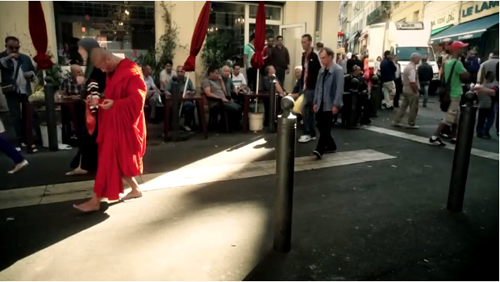
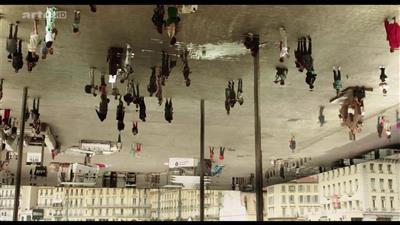
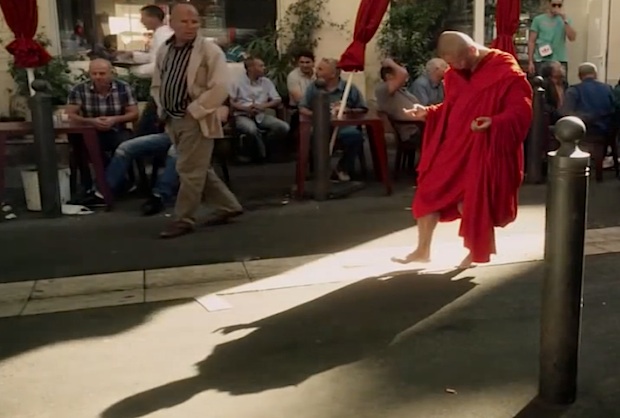
A girl wanders by the red-robed Asian man, staring. She comes closer, and then draws away, unable to make out any purpose. A woman also passes by, nervously notices the monk, takes a picture and then giggles, and saunters down the stairs. Many people pass by the Metro stairway, all politely ignoring the monk, avoiding him, pretending not to see him except for the girl, who is still transfixed.
She then hears a male voice clearly state, “Freak.”
She turns to the man, and find that he too is staring, although disinterestedly, at the slow moving monk.
Since he seems to be the only one with any interest in the man, she asks, “Why does he walk so slow?”
The passerby responds, “He is just some crazy Asian.”
Dissatisfied, she asks again, “Why does he walk so deliberately?”
The man spits at the monk’s feet and says, “He’s probably some dirty protester. Wanting to shame us into not walking so quickly, to show off his ability and to demonstrate that we are all heathen for not taking up his disgustingly slow ways.”
Another man stops and speaks. “I have heard of this condition. Oliver Sacks speaks of it. There are people who’s time sense is remarkably different than our own, and while they consider themselves acting and walking at the same time as the rest of us, from our perspective they are standing still, not communicating. From their point of view, we are the ones who cannot stand still, who never finish a conversation.”
“That’s ridiculous,” said the first man. “No one is like that.”
“Well, I suppose you shall have to take that up with Dr. Sacks.” And both men left, one down the stairs, the other up.
A woman then came close to the girl and spoke quietly to her, “He is a performer. See? He is always striving toward the light. He desires the light, for he desires attention. Because he is in the light, see how the red of his robes reflects and bleeds all over the stairs, creating a symphony of color. He does this, not for any protest, but because he wants to give the rest of us joy.”
An Asian woman, dressed in a suit, looking quite proper heard this and said in a clear, loud voice, “He is the Walker. He is the ultimate radical Buddhist.”
“Ha!” said a young female, dressed to the nines. “I don’t think he’s Buddhist. He’s not even human. How can he be? He walks this way for hours—I know, for I saw him on the station earlier today—and he doesn’t cough, doesn’t sneeze, never stumbles, I’m not even certain he breathes. He must be a robot.”
The Asian woman mildly addressed the fab girl, “Have you ever learned a musical instrument?”
“Sure, my mom made me take piano.”
“When you played the piano, in your course of study, did you ever get to the point where you ignored the notes and just played, forgetting all that you were taught about time and pitch and chord and just played because it was in your heart and in forgetting all your lessons, you knew, at that moment, that you had learned them all perfectly, for they were just flowing out of you?”
“I suppose… Yes. Yes, I did. When playing Ode to Joy at times it wasn’t a bunch of notes, but it was real music.”
“That, my dear, is called discipline. It is when a human fully adopts a learned behavior that it becomes second nature to him. We can do it with anything—reading, typing, singing, talking, jumprope, video games—actions that become such a part of us that we do it without thinking, without considering what exactly we are doing. So is this man seemingly ‘not human’, for he is so practiced at his art, his ethic, that he need not consider his actions.
“And yet consider is exactly what he is doing. Little girl, I believe you asked why he is walking so slow? He is doing that because every life is precious. When we walk by quickly, when we speed by in our cars, when we fly in our airplanes, we pass hundreds, thousands even millions of separate living organisms every split second. Some we pass by, some we trod on, some we breathe in, some we simply ignore… because we are moving too fast to take notice.
“This man, the Walker, and those who follow him, are the ones who slow down so that they might have the opportunity to notice every life. To notice the life around us is the first step of compassion. To have compassion is, at the very least, to refrain from taking a life that we might otherwise destroy without even knowing they exist. To have compassion is to recognize the equality of life in an insect, in an amoeba, and giving them their due. The Walker moves slowly so that life may be seen and honored by him. He is the true Buddhist.”
A group of young men stopped and listened to her lecture, and one man at the front asked her, “So are you saying that the best man is the one who is in a coma? The one who never moves, who never eats, but drinks from an IV? Even this monk steps on insects. He just knows he’s doing it. Wouldn’t it be better if he were completely still?”
“No. For he walks on the earth, not in a hermitage, but in the cities where thousands may see him and consider. If they consider him, perhaps they will consider other life as well. Perhaps they will learn the lesson of slowness and compassion. Some have already taken on this task. He is not just an observer, but a teacher to all who observe.”
And she briskly walks away to her next appointment.
The group of young men looked at each other and laughed uproariously. The leader walked up to the Walker and spoke loudly to him, “So, grandpa, I think what she said was a bunch of horseshit, what do you think?”
The man in red continued his agonizingly slow descent.
“I think this gentlemen needs some help down the stairs, what do you think, men?”
“Certainly. I would love to help the gentleman.”
“Well, fine. I will take this arm, and you take the other.”
They gripped his arms and picked him up. He remained still, as if he were still standing on the stairs. Then one and the other threw his arms forward, causing him to descend the rest of the staircase through the air and land with a hard thump on the concrete pad below.
“Aren’t you grateful? Have you no ‘thank you’ for us?”
The group of five surrounded him, kicking him and beating him, calling him ethnic slurs and filthy names.
Finally, their thirst for violence quenched, they stopped. The leader looked up at the little girl, who saw the whole incident. He cocked his head, tipped his hat and said, “That’s what happens to you when you stand out, you know. Better to just be like everyone else.” And they went their way as the little girl’s tears fell on the concrete.
You would think that being a good person is just pats on the back and accolades. Rather, the cliche is too often true: "No good deed goes unpunished."
Goodness isn't the same as just being responsible. Anyone can support their family, be a good provider. Goodness is that extra step of self-sacrifice. It is being the parent who is gentle with the teenager when she is screaming at your face. It is the neighbor who doesn't complain about the next door mess, but comes over to help them clean it.
Certain people are given the social position of being a mini-saint: teachers, social workers, medical workers, religious leaders. They have an additional responsibility of goodness. They are given the task to not only work for their family or themselves, but their whole community. They are not allowed to slip up, to say that which is inappropriate, to bend or break community standards. They cannot scream at their objects of help, they cannot take advantage of them, or else they will rightly be accused of harming the vulnerable. They are held to a higher standard.
Normal people compromise their standards. That is seen as being human. They will give up, be prejudiced, even hate, and that is fine. They understand that being human is weak, that everyone breaks at times. But the good person may never break, never give up. They must always be strong in goodness, always put on a good face. Unfortunately, this means that every good person is an implied accusation to those who get drunk, who give into their hatred, who refuse to forgive, who allow life to break them. The good person is an offense to those who are normal. Thus, the normal person must constantly buffer the good, to force them to display their humanity, to show that they aren't any better than anyone else.
The good are threatened, they are called names, they are accused of that which they did not do, they are given motives that they never thought of, their children are threatened, they are beaten, they have fists in their face, they are screamed at, they are hated. They are tempted with sex, with drugs. This happens to them so they will break and show hate and prove their weakness, and so prove their humanity.
Of course, the good are human. Every human has a certain level of will power. Some have more and some have less. Will can be exercised, like a muscle and it can also atrophy or be overworked and strained. But no matter who we are, we only have so much will power to work with in our lives. We focus our will on certain things, which means we don't have will to put into other aspects of our lives. A surgeon might spend so much focus on precision in cutting and creativity in repairing the human body, that they might not have energy to put into being polite to their patients. A mother may spend so much time and energy on her toddler that she doesn't have enough "get up and go" to clean the house. We may disagree as to how a person spends their limited will and energy, but we must admit that no one can do everything. This is why the normal person is compromised.
What is rarely known is that the good person is also limited. It is just that they focus their will on being good to others, in being compassionate, in assisting the vulnerable. This means that other aspects of their lives are reduced. The priest won't spend time on fixing up his room, the pastor may not spend time with his family, the compassionate person may be addicted to pornography, the teacher uses much of the summer break recuperating from the rest of the year.
And, of course, the good person may very well break. They might get tired of the accusations and strike back. They might neglect their family or have an affair. They might give way to a stroke. They might fall into severe depression or other mental illness. They might become a hermit or become self-focused.
But what happens if a good person doesn't have any severe breaks? What if they just move to a different community? Or, God forbid, suddenly die? It is then that they really become a saint to the community. A saint is only safe after they are no longer available to be an accusation. They can be lauded and statues can be made for them and they can be safely regarded as a community hero. People might even change after they are gone, seeing their strength and goodness as an example. Their struggles and difficulties are seen as a passion, a legend of their goodness.
The only loved saint is the one who is no longer there.
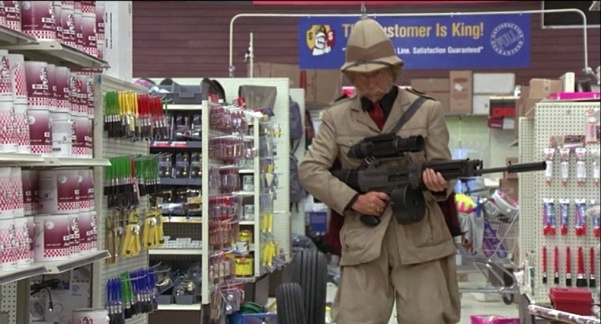
Michael is spending the afterlife in this theatre. Must be the popcorn.
Movies are central to my life. On average, I participate in about two hours of movie-watching daily. That’s more than seven hundred hours a year. If I keep this pace up I might chalk up perhaps 35,000 hours in my adult life. Some would say that as a pastor, or a Christian, movies shouldn’t take such a large part of my existence. I should spend that time in prayer, perhaps or Bible reading. I don’t know, perhaps I should. But I spend my life living with and working with people who deal with tragedy on an everyday basis, so I figure I’m deserved a break at times.
I have a friend of mine who looks at my bookshelf every once in a while and aloud wonders at the large amount of fiction books, as if there is a problem with good Christians reading fiction. Some people have the same idea about movies, as if they are a “waste of time” and unworthy of a productive life. Well, I lead what I consider to be a pretty productive life, and movies play their part in that. Below are some reasons why.
I think that my wife might exchange the word “books” for my word “movies”. And I think that any form of art might be able to take the place of movies in my life, if they were as integral. So feel free to put “music” “fiction” “poetry” “art” or whatever else connects to you in place of my focus on movies. Just one other thing: I’ll be speaking specifically about watching DVDs at home, because I rarely get out to the theatre.
Tell your boyfriend goodbye!
Because I need a break from life
I’m a busy guy. I know this because everyone tells me I am. And I know this because after a day of working, I am exhausted, ready to collapse. As an introvert, I need to take a break from people and their demands, just to recharge. Watching a film allows me to be passive while my mind is active. It allows me to interact with two-dimensional beings on my own terms. I can decide if they will make me laugh or sad. I can decide if I’ve had enough of them and just need a break for a moment. I can turn down the volume if they are too loud, and freeze them if I need to use the restroom or get something to eat. For a few moments, I’m in control of my surroundings.
This may make me sound like a power-hungry control freak. But it is because I feel so out of control for most of my life that I feel I need an arena in which I can control. People think I am in charge of a lot, but actually I see a reality that is best for others, and strive to reach that reality. I live most of my life trying to meet people’s needs and to meet their expectations. When it’s just me and a movie, then I can meet my own needs for a bit, and these two dimensional beings act for my benefit. This doesn’t mean they always do what I want, not at all. And that’s part of the joyful surprise.
Kubrick, to what horror-filled place did you send me?
Because I want to expand my experiences
In 1983, before Christopher Walken was only playing scary guys, he starred in a B-grade sci-fi called Brainstorm. The idea of the film was a technology was developed in which one can “videotape” experiences, tapping one’s experience in the mind and placing that full experience into another person’s brain. Someone could learn piano this way, or experience a roller coaster or re-live someone else’s tragedy.
To a lesser degree, this is what movies are like. Saving Private Ryan, in the twenty minute D-Day scene, gave non-combatants a sense of what the constant danger of a battle means. Ordet allows us a glimpse of what the disciples experienced of Jesus’ passion (more so than the over-brutal Passion of the Christ). Amadeus helps us view Mozart’s music through one who truly loves and hates it. At times movies give us an opportunity to empathize with those we might never want to, like The Godfather or Citizen Kane, but we obtain a new perspective on humanity as a whole by experiencing these lives.
A life with art expands our experiences to accomplish what we will never do ourselves. Art can help us climb Everest, can walk us through Dante’s Inferno, can help us empathize with an evildoer and can give us a sense of being a saint. Without art, we will be limited to just who we are, without being anyone else, which leaves us poorer human beings.
Because I need an outlet for my emotions
My job pretty much is that of a social worker. I listen to stories of tragedy all day long and my task is to solve problems, erase difficulties, point toward solutions. All too often I hear the worst of tales and there is nothing I can do… nothing anyone can do. Yet it is my role to remain stoic, to be calm and not to worsen their own fate by causing it to be more dramatic than they can handle. I am level-headed, looking for help. I make sure they know I take their problems seriously, but I am a solver, not an emoter. Meanwhile, I pack this tragedy into my heart, stuffing it with the hundreds, thousands of stories that I have heard. They are all packed in there so tightly, that they are in danger of bursting out, often in frustration or anger. Frustration that there is nothing to be done. Anger because I feel overburdened with tragedy, not a single one of my making.
I know of a mental health organization where each social worker is required to see a therapist monthly, to process the stories they obtain from their clients. That’s a great idea, but not everyone can afford this, or have employers who can afford this. My therapy is film. Occasionally, the right time and the right film meet and I am able to release my pent-up emotions. I wept watching Wendy and Lucy, tears streamed down my fact at Joyeux Noel, and I openly sobbed at the musical of Les Miserables. I didn’t used to cry at films, but now I look for the opportunity. Life for many is tragic, and we all need an opportunity to let it go.
Of course, some ideas are better to never have heard...
Because I want to learn new ideas
Along with expanding my experiential horizon, movies can help me do what I most enjoy: explore new concepts. I am a concept junkie. I love seeing things from a new perspective, opening up doors in my brain that I have never explored before. Books like Thinking Fast and Slow are like a whole bundle of Christmas presents, each chapter exploring a new, shiny bauble for me to play with and examine.
Even so, certain films open up my mind to ideas never realized. The Mission (1986) introduced pacifism and fighting for justice from a Christian perspective to me. The idea of mercy as being the foundation of the universe is explored by Tree of Life. The idea of growth through discipline and adversity is explored by Groundhog Day. Many of my favorite films not only give me compelling characters and entertain me, but also create new thoughts, which I can use later in my life.
Jack and I are feelin' good
Because I need an emotional uplift
I am of a melancholic nature. I’m more comfortable with the sad story than the happy one. I expect life to be unhappy, and thus far life hasn’t disappointed me. But I can get to an emotional state in which I am no longer able to play well with others. I can be moody, withdrawn or sullen. It used to be when I got in that kind of mood, I would bask in depressing music and wallow in my dark mood.
This doesn’t work so well for a marriage, I found. My wife never understood my dark moods, and my children just simply ignored them, running over them roughshod. As my responsibilities grew, I found that I wasn’t allowed the luxury of melancholia. So I sought an out, and movies and television provided me an opportunity.
If I need a cheerful (but sarcastic) disposition, then I can watch a couple episodes of Gilmore Girls and I laugh myself into a better mood. If I need a burst of energy, I can watch Die Hard or a Star Wars film. If I need to be productive and fast-paced, an episode or two of West Wing does the trick. Film provides a mood changer, providing both a setting and characters for me to conform to.
There's a limit to how deep I want my experiences to go
Because I want to learn about modern cultures most powerful art form
The world is a complex place. It always was, and always will be. Art gives us an opportunity to explore the vastness of the world and of the universe, both in its reality and its possibilities. The worst of art only tells us what we already know, enforcing our preconceptions. The best of art opens up old worlds that we never knew existed, and new minds that sees the world in a way we could never perceive without art.
Film is not the newest art form but, along with novels, it is the deepest experience. When watching Gravity, we might experience floating in space. When watching Rabbit Proof Fence, we not only learn about a period of history we might not know about, but from a perspective that we would never read about outside of fiction. Through film we can be surrounded by a world, step into it and observe it, feel it and know what it means to be a character in that world.
Someday perhaps a virtual reality might give us that kind of experience. But right now, in this era, it is the time of movies. In a matter of an hour and a half, we can live a life we have never dreamed of in an area of the world we may have never thought of before. Yes, often we are simply riding the rails inside of a couple artists’ minds, but when we have a remarkable artist, isn’t it worth it?
Because of movies, I find that I am a richer, more complex person. I am more stable and (if I don’t keep talking about movies all the time) more interesting. Movies take the ins and outs of my everyday experience and allows me to see the sparkle in the humdrum, the significance of the mundane. I laugh at what others do not see and understand the sorrow that no one sees.
Last week, I had a friend of mine tell me that I lived a double-standard. That wouldn't have been so bad by itself, but she based it on a statement that she remembered me making that I had never made, nor implied. And no matter how much I clarified my point of view, it did not change her judgment of me.
I was watching a fantastic episode of the West Wing ("Isaac and Ishmael") in which an Arab American was accused of being a terrorist, and every time that he was previously falsely accused of this before was being brought up against him as proof of his guilt in this circumstance.
It is a commonplace that we live in a world of pain and that the hardest story must be the truest one. "You may not like it, but it's true." But in reality, this assumption that the most difficult must be true leads us to false judgments. The Passion of the Christ is brutal... in reality TOO brutal. Historically, it is inaccurate because there are too many beatings and too much blood.
When we take this point of view to our lives, we find that we think the worst about people because it is the "harsh reality" we believe in, not because there is any real evidence of the fact.
The Hunt is a Danish film that shows us the experience of a man in a small community when he is falsely accused of sexually molesting a close friend's child. This is a difficult movie, because the reactions of the community seem so idiotic and unnecessarily judgmental of a man whom they have lived with and loved for decades. But when we see it, we recognize that it is true. People really are that idiotic, because they often assume the worst.
The Hunt gives us the harsh reality that reality is more harsh when we assume the worst. The worst criminal activity happens when people assume someone is a criminal, with or without evidence. Our fears create more harm against the innocent than they protect the innocent.
The Hunt deals with judgmentalism and forgiveness by just telling the story of an individual that applies to everyday situations, much as the Dardenne brothers do. Each performance is remarkable in the everyday quality of the reactions, despite the unique circumstances. By the end of the film, I was telling characters what to do or not do at the top of my voice. I apologize to my wife. She told me that I shouldn't watch it.
Despite my wife's objections, I highly recommend the film to those who prefer their morality dramas to be fully human and complex.