Tuesday, September 27, 2016

The American Religion

The central tenets of the American religion are these:
1. If you can get rich, you should.
2. You can get rich.
We have churches dedicated to these beliefs, for which there is no evidence (you have to take it on faith). There is a whole mass media dedicated to this religion, including "Think and Grow Rich", which sold 70 million copies and somehow did not end the depression. Every presidential election (the election of the new priest of America) has one major candidate which promotes this religion.
And this religion has their sinners: the poor. They are the ones who, according to this faith, reject wealth and then demand to be assisted because of their own decision. And these sinners try to make the faithful guilty for their "filthy, disgusting" lives. So they are forced by this religion to live a hell on earth by increasing their poverty and pouring shame upon them.
Reject this religion. Be freed from it's condemnation of those who are not rich, which likely includes you. Recognize that being rich or poor is chance, more than anything else, and that the poor have the responsibility to work on surviving and the wealthy have the responsibility to be grateful and to help those who have fewer resources than they.

Sunday, September 25, 2016

Why Do Churchies Not Read Their Bibles?

Most church-goers do not read the Bible, even though almost all of them have one. There’s a couple reasons for that.

First, because the Bible is way more difficult of a book than sermons make it seem. We want our Bibles to be like children’s Bibles, full of stories and to the point. However, it turns out that this millennia old volume was written to ancient people, not us. It is full of genealogies, laws, architectural notes and rantings about ancient politics. It has an extraordinary amount of cultural detail that isn’t explained. Most people who pick it up to read it cover to cover give up by Exodus, if they even make it that far. Frankly, its much easier to pay someone else to study it and explain it to us, like churches have done for thousands of years.

Second, the Bible isn’t necessary to live a spiritual life. Love is, Jesus is, God’s spirit is, but the Bible isn’t the only door to open up a person’s spirituality. For some people it really works and for others it causes them to kill their spiritual life by diving into arguments about detailed interpretations.

 No one should complain to people about not reading their Bible. They should complain if they fail to love as Jesus loved.

Wednesday, September 21, 2016

Where is God?

Wherever one's heart is filled with compassion and they act for the benefit of another, God is present and working.
Even in spaces where apathy, violence and unjust anger rule, God is right around the corner, looking for the opportunity to create love.

Sunday, September 11, 2016

On Brokenness

Once there was a blind man named Bill.  Bill was a kind person, always helpful, he had a pretty good sense of direction, really, for being a blind person, and he could tell people how to get anywhere.  He was generally of a friendly disposition and he loved children and pets.

His main problem was that he didn’t know he was blind.

He strongly suspected it.  He knew he wasn’t perfect.  He made mistakes.  Heck, everyone does.  But he couldn’t admit that he had a problem that no one else had.  He thought that everyone listened to the television, lost in mystery.  He thought everyone ran into poles on a regular basis when they walked down the street.  He thought that perhaps he was a bit more clumsy than others.  But it wasn’t a big deal.

Of course, everyone who spent time with him knew.  He kept his eyes closed, since they were useless, so at first people just wondered why he kept his eyes closed.  Then they realized the obvious truth, so they figured that he was just a really independently-minded blind man.  They didn’t say anything to him about it.  After all, it wasn’t their business.

All this was fine until one day Bill ran across a child who was lost.  When he would meet an adult who needed directions, he would just tell them verbally in his even, precise tone.  And the adult would get there, no problem. 

This time Bill considered that he should direct the child by hand.  After all, the child needed more protection.  So he took her by the hand and led her down the streets and paths that he knew so well in his mind. 

But he couldn’t see the ditch he ran her into.

And he didn’t see the tree that he ran her into.

He didn’t see the silent dog that bit her on the path.

When she just cried, louder and louder, he comforted her and told her, “Don’t worry, we’ll be home soon.”

When he did take her home, she was so beaten and broken that the child’s mother called the police and had him arrested for child abuse.   When he was told of the charges, he said, “But all I was trying to do is help.”

* * *

I am broken. 

Some of my brokenness is sin, but not all of it.  I have weaknesses, injuries, trauma and mental deficiencies that make me less capable, less of a loving person.  It is not accurate to say "I am a sinner".  Rather, I am broken.  I can't accomplish all that I should.  Or that I feel I should.  I am broken.

So are you. And everyone we know. Which means we need to be patient with each other. We are all broken in different ways, and we don't trust the way other people are broken. 

We could understand if everyone were broken in the same way. But because we are all broken differently, it is even more important to work at understanding.

But it is not enough to know that we are broken.  We must know what our brokenness is, and how our brokenness can hurt others.  There are people all around us who are vulnerable to our weaknesses, and we may not know how we can hurt them, unless we look into it.

We need to know ourselves.  Not just our personalities, not just our types, but we need to know how we are broken and how we can hurt others.  We might be able to be fixed, in some ways.  We may not.  But we have to take care not to be ignorant enough of our brokenness that we hurt others.

Part of loving others is to know how we are broken.

Part of loving others is to give ourselves space so our brokenness doesn’t harm others.

Part of loving others is to take care around people who might be especially vulnerable to our brokenness.

It is not enough to see how my brokenness affects myself, but also others.  I must be aware of those who will be hurt by my brokenness, although I never meant to hurt them.

This week I hurt people.  I was wounded by trauma and I ended up wounding others because of the trauma I experienced.  

I was hurt enough that I shouted at a mentally ill person, who experienced her own trauma.  Later, I apologized.  And she wept, openly, because I admitted my own weakness and response.  That didn't heal her.  But perhaps it healed part of our relationship.  I hope so.

I want to be more aware of how I harm others because of the harm placed upon me.

Father, may my brokenness never cause another to be broken.  Let the cycle stop here.

On Holy Artifacts

There are no holy books.

There are no holy places.

There are no holy objects, no holy artifacts, no holy clothing.

A single artifact can be used to bring someone to God or to rape a child. The same book or phrase can be used to stir love or hate. The best an object can be is potentially holy, not objectively so.

The Spirit infuses in us a desire and drive and energy toward compassion, love and mercy. We choose to obey that drive and so produce a holy, compassionate act. A holy act of love can lead to a holy, merciful habit. A holy habit can become a holy, loving life.

Father, deliver us from those who use what seems to be holy to produce unloving action.

Friday, August 12, 2016

How Should we Read the Bible?

“You do not have His word abiding in you, for you do not believe Him whom He sent.  You search the Scriptures because you think in them you have eternal life…”  -Jesus

There’s a lot of people who think that salvation is found in the Scriptures.  I’m here to tell you, it isn’t true. 

That’s a pretty shocking thing to hear from a guy who’s still pretty much evangelical.  I mean, aren’t we supposed to be all about Sola Scriptura—salvation by Scripture alone?  As an Anabaptist, aren’t I supposed to believe that anyone can find salvation, the truth and hope of God, by just picking up a Bible and reading it?

Well, if you’re looking for me to believe something just because its “evangelical” or “Anabaptist” I think you will be pretty much disappointed.  Mind you, I certainly believe that the Bible holds the truth and that this truth can lead you to salvation.  But the Bible isn’t salvation in and of itself.  And clear-thinking people can get the Scripture wrong.  Really, really wrong.

Look at the Jewish leaders Jesus was speaking to.  They knew the Scriptures quite well.  Better than you or I do, that’s for sure.   But here is Jesus, in John 5, telling them that all their Bible studies and memorization and analyses were wrong.  They were doing all they could with the Bible, and they were dead wrong.  Dead, as in God’s judgment dead.  That’s pretty dead.

There’s a right and wrong way to read the Bible.  Let’s talk about the right way, and we’ll look at some wrong ways.

How to read the Bible:
You're Reading it Wrong
1.      Look for God’s care
Whatever was written in earlier times was written for our instruction, so that through perseverance and the encouragement of the Scriptures we might have hope. (Rom 15:4 NAU)
People often look at the Scriptures and they find a horrible God in the Old Testament and a loving, kind God in the New Testament.  But Scripture was not written to terrify us, but to give us hope.  God is and always has been a God of love.  Yes, in the NT it says that God is love, that God so loved the world.  But in the OT the foundational statement about God is: “Yahweh, Yahweh God is gracious and compassionate, slow to anger, abounding in lovingkindness…” (Exodus 34:6).  If we are looking for God’s hatred, then we are reading the Bible wrong.  Certainly the Bible says that God hates sin, but he loves all people, no matter who they are, what they’ve done or how much they personally irritate you.  We need to look for God’s deliverance, God’s compassion, God’s mercy and God’s acts of salvation.  If we look for destruction or hatred, we are reading it wrong.  Throughout the Bible God is the Father, not the Destroyer.

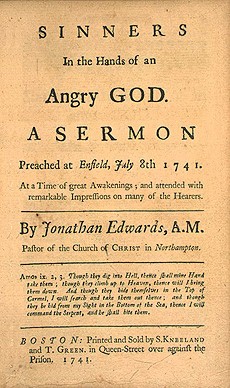
Pastor Edwards, you're doing it wrong
2.      Look for Jesus 
And the Father who sent Me, He has testified of Me...You search the Scriptures because you think that in them you have eternal life; it is these that testify about Me. John 5:37-38

When we read the Bible, we should be looking for Jesus, if we are reading it right.  Some want to see Jesus’ death in every verse, or look for Jesus’ presence behind each bush.  I think this is the wrong approach.  I think Jesus lead us to play the game “Where’s Jesus”in a couple different ways:

a.       See Jesus as fulfillment
Jesus said that he came to fulfill the Scriptures.  This means that he came to live out prophecies, but also to fix all that was wrong about the Bible.  The Bible contains a lot of failures (one of the best things about Scripture), but for every failure, Jesus is there to be the success.  David sinned, big time, Jesus was without sin.  Israel didn’t trust in the Father, Jesus completely trusted.  For every prophecy, for every failure, we should see Jesus as the answer.

b.       See Jesus’ principles
Jesus taught the Scriptures himself, and He taught how the Scriptures should be used as a guidebook to life.  Jesus taught us to look for mercy, for grace, for love.  We should re-interpret the Bible as a way to understand what Jesus taught us.

Calvin, you're doing it wrong
3.      Look for what we should do
Prove yourselves doers of the word, and not merely hearers who delude themselves. (James 1:22)
Many people see the Bible as a book of doctrines, of a list of things to believe.  They want to find precisely what the Bible teaches so that we can have our teachings in line, believe the right things, and so be saved.  However, the Bible tells us that we should see the Scriptures as a way to live, a guide to a particular lifestyle.  If we are only looking for things to believe, we are reading the Bible wrong.  Rather, the Bible should change how we live, point at what we should do in order to be pleasing to God, and to live in harmony with each other.


Guess who's reading it wrong?
4.      Look for love
If you had known what this means, 'I desire compassion and not sacrifice,' you would not have condemned the innocent. (Matthew 12:7)
You search the Scriptures because in them you think you have eternal life... I know that you do not have the love of God in you. (John 5:39, 42)
And now we come back to the beginning.  Even as we should be searching the Bible for God’s compassion, so we should be seeking out our own.  If we use the Bible as an excuse to hate or to reject someone, we are reading it wrong.  The Bible is there, according to Jesus, to teach us to live in compassion, grace, mercy and encouragement.  If we use the Bible to enact our prejudices, our oppressions, our greed or our ambition, we are using it wrong. 

According to Jesus, the context of the Bible, the whole Bible, is love.  If we read hate in it, then we are reading wrong.  Yes, there are acts of hatred, vengeance, prejudice in the Bible.  I won’t deny it.  But these acts should be even more startling when we learn “God is love” and we are to love all people, even those who do us wrong.   Jesus is the fulfillment of Scripture, and all scripture should point to God’s deliverance of the needy, and the hope that God gives to all of us. 


Please, don’t read the Bible wrong.


Sunday, August 7, 2016

Dumpster Halo

Ben had been panhandling in front of the local burger shop, to no effect.  He walked a half mile to a grocery store, jaunted around the back and came to the dumpster.  He noted that the bag of collected Chinese food from the deli had not yet been dumped.  He started picking through the salads, when he was interrupted.

“Hey, what are you doing in there?”

“I am gathering food for myself and my brothers.”

“Why don’t you get a job, earn some decent money and then you can come into the front of the store like a human being?”

Ben stood tall, with the soles of his shoes deep in the goo all dumpsters secretly prize as their own creation.  “I do not get a job, fine sir, because I am called by the Lord God to live in poverty, from town to town, to recollect to all the love of Christ, who was homeless and poor.

“I do not earn decent money, because there is nothing decent about money, but it is but a trap to choke the life of those who have little to begin with.

“And finally, I am a full human being.  Full of mercy, full of compassion, full of spirit, full of joy.  It is you, sir, whose humanity I might question.

“Be a new man and follow the poor Christ, as I do.”

The manager wavered for a moment, and to fill the stunned silence, he responds, “Are you some kind of pastor?”


“No,” Ben chuckles.  “I am just a poor and ignorant bum.”