Wednesday, April 16, 2014

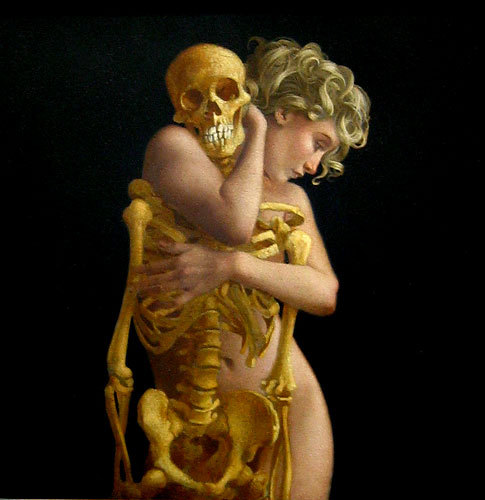
Three Deaths: Meditation for Good Friday

The penultimate death is this:
The underground passage to an unknown land;
The unseen forest creek leading to the deep ocean;
Eternal darkness of hidden rest;
The track divided, whether right or left we have already chosen.
It is a separation from all we love and rapture we have known to plunge into
A solemn welcome to the sea of hidden humanity.
The masses fear it
but we all must travel

The master Death is this:
He awakes you every morning, sorrow lowering your brow;
You roll over, wondering which way he will abuse your body;
He plants today the brutal children in your path, threatening, battering;
He is the menace in the officer’s gaze as he destroys your safety;
He is the fist of the skinhead landing on your face, your gut, your crown;
He is your rapist, thrusting his hell within you;
He is the kidnapper, forcing you to kill or be killed;
He is the comfort of the liar, easing us all to the ideas of war and famine;
He is the persistent nausea and pain of what another calls “healing”;
He is the slow quiet desperation, certain of an untimely ending.
He is living dystopia
For all the lowly.


The defeating death is this:
The newborn father awaking to give the mother respite;
Forgiving he who stole your life;
Giving the last coin to bring the injured to a healer;
Remaining awake all night to prevent a friend’s suicide;
Quitting your job because they abuse the poor;
Standing  before the soldier that he won’t shoot the innocent;
Daily waking exhausted to serve those without hope;
Becoming a slave to comfort the slave
Healing lepers and so becoming a leper;
Serving prisoners as a prisoner;
Ending on a hateful blade.
Embracing the master
Is death’s defeat.

Monday, April 14, 2014

Monoculturalism Destroys the World

Everyone wants to battle prejudice. To label people by their group, to stereotype an individual by who they look like or false ideas about their group is a horrendous crime. However, sociology teaches us that this is not a crime that we can just point at and jeer, but rather it is a sin within our own hearts. There is not a single person who has ever lived who has not made a determination of another’s personality, goals or vices based solely on one’s looks, one’s accent, one’s clothes or the people one is friendly with. Labeling on insufficient evidence is hardwired within us, and we will all stumble because we assume that our current experience with a person is based on a previous experience or story of an experience with someone we put in their same category. To confront a bigot, all we have to do is talk to the mirror.

It is for this reason that many Western societies have targeted certain areas of prejudice. We have laws against some forms of racism and sexism. We decry homophobia and religious bigotry. And so we should. Because to limit one’s rights or ability to survive due to one’s beliefs, one’s sex, one’s race or one’s sexual orientation is wrong. Every adult, without exception, should be allowed to make their own decisions about how to meet their needs, as long as it does not harm another. If one person has the money for an apartment, then all who can afford it and not harm others should get the same apartment. If one person can sit in a bar to drink, then all should be allowed. This is what Martin Luther King Jr. died for.

There is far to go in these focuses. Yes, an African American has been elected president, but thirty six percent of all abortions in the United States are on minorities, and 40 percent of all prisoners are African Americans. Yes, women are now able to succeed in almost any occupation men used to hold a monopoly on, but women still only make 77 cents for every dollar a man makes. Most people have the freedom to worship as they please, but any Muslim appointed to a high government position will soon have to resign because of false allegations that they have associated with terrorist groups. With prejudice, the work is never done.

With as much work as must be done on the bigotry that has been targeted, there is a problem with speaking of racism, or sexism or whatever other focus one has. For every prejudice our society focuses on and tries to wipe out, a hundred are ignored and five more are created. Yes, our society has made great strides in sexism, but assumptions are publicly made daily about the poor who receive welfare—that they are lazy, are cheating the system, are taking advantage of the government. Racism has changed and in some ways gone underground, but social workers can manipulate and control the lives of the mentally ill because the mentally ill have been deemed unable to care for themselves, even when they are not under a court-ordered commitment. People are allowed to worship as they please, but people who have pot for their own use are thrown into prison, although they have harmed no one—not even themselves.

The list of prejudices go on and on—the homeless are treated like criminals for not having a place to sleep, an immigrant is treated like an idiot for having an accent, someone who criticizes democracy or capitalism is held at arm’s length, distrusted, a person over 80 is treated as unable to make their own life decisions. Why is this? Not because we haven’t been taught about tolerance. Simply because our teaching of tolerance has been limited to only a few categories. Thus, we who are white males feel guilty at just glancing at a young black man, but we can openly speak hatred against the same man if we find out he is homeless and speaks with an African accent.

The issue is not racism, or sexism or any other -ism of limited scope. Our prejudice is against those who are unlike ourselves—of any other culture that is unfamiliar and uncomfortable. When one person or a group of people make a values decision that is different than one we would make—whether or not it would hurt another—that person is wrong and potentially dangerous. The different are not allowed to rule the society, because they will not uphold the cultural standards, whatever they may be. No matter how we try to attack bigotry, as long as we limit it to just a few issues, we will always fall behind our own unknown prejudices. I believe that our problem is not racism or homophobia—rather it is monoculturalism. The limitation of the “acceptable life” to only a few choices.

Our problem is not simply a lack of education. Certainly Americans would be more tolerant if they learned more about cultures, religions, and a variety of cultural mores and habits. But knowledge is not the answer to a monocultural outlook. The prejudice against women persisted for centuries because there was a mutual agreement between the sexes to not interfere with each other’s way of life, mores and areas of influence. Only when they began to live as equals, interfering with each other’s lives was there the beginning of understanding and a breaking down of the wall of sexism. The prejudice against African Americans persisted (and will continue to persist) as long as there is separation in neighborhoods, schools and cultural blocks. Only when there is a free and equal mixing between races will understanding and true hope come about.

And we cannot solve monoculturalism by just mashing neighborhoods together, because in the war of culture, the more dominant culture will always win, simply because they have more resources. The dominant culture will be quite "rational" when they dismantle the cultural values and visions of the non-dominant cultures.  And if rationality does not work, then brute force always does.  A homeless camp on private property, although neat and orderly, will be dismantled and all possessions stolen by a local government.  A neighborhood association will fine a house that holds to a different cultural standard from the houses around it.

I believe that the answer to monoculturalism is living in other cultures, being humble in a situation apart from that which we grew up. When I visited India, after living my whole life in Southern California, I was confronted and ashamed by some of the things I did which was acceptable in my own society. I learned that not only were different races, religions and languages acceptable, but so were different ways of thought. When I began to live among the poor, I learned that there was much that I had an instant revulsion to—dumpster diving, for one—that was not only acceptable, but actually a moral benefit to society.  We who are a part of a dominant culture need to live as a minority culture to understand how to recognize and protect minority cultures.

Only if we live humbly among different cultures will we learn to accept other cultures. Only if we are forced to confront our prejudices face to face with those who we appreciate but run in the face of our prejudices will we change.
Sunday, April 13, 2014

Books on the Road to Damascus

I am a white male evangelical who repented.  I didn’t repent from being white or male, which I couldn’t help, and I understand from my science friends that it has to do with some genetic whoozawitz.  I still retain much that is evangelical, although my evangelical friends might disagree.   My repentance has not as much to do with being white or Christian, but it has much to do with the books I read.

It was a book that caused me to think that giving up everything I had and surrendering my life in service to the poor was a good idea.  It was a book that showed me that normal charity just wasn’t enough. It was a book that taught me that compassion to those not like us is the best way to live. It was a book that taught me that the Bible wasn’t written to the middle class evangelicals, but to outliers of society, and the best way to understand THAT book was to read it from their perspective. 

Clearly the lesson here is: Books are dangerous.  At least if you want to keep your life intact.

Obviously, not every book is dangerous.  I think reading Terry Pratchett is generally safe.  Or The Purpose Driven Life.  Or Jesus Calling.  I’m not saying that these books can’t  be inspirational or entertaining or even powerful.  But they can never be dangerous.  They aren’t the kind of books that take your life by the throat, choke out your last breath, toss you to the ground and say, “Now get up and walk.”  

There are books that speak to my privileged state as a white, relatively well-off, conservative evangelical  and says, “You know that this is not all there is to Jesus.”

Below are some books that belong to the “challenge the narrow-minded Christian” genre.  These are books that talk about how the author went through a process of paradigm shift and invites us to make that same change, to see the world in a different way than we did originally.  To see the world in a way closer to how Jesus saw it and sees it.  Yes, these books are all written by white male evangelicals.  But like the movie Knocked Up, these are books about male religious “slobs” who come to mature in powerful ways because a Lover taught them new ways to love.

Surprised by the Power of the Spirit by Jack Deere
Jack was a pastor of a moderate evangelical church who believed that the charismatic was of the devil and needed to be stopped.  This book details his journey to become a charismatic himself, not because of doctrine or theology (although that comes into play), but through the work of God.   It’s a well-told story, and Jack shows that his exclusionist theology was cutting off God’s work in his life.
http://www.amazon.com/Surprised-Power-Spirit-Zondervan-ebook/dp/B003TFE1QW/ref=sr_1_1?s=books&ie=UTF8&qid=1397415552&sr=1-1&keywords=suprised+by+the+power+of+the+spirit

The Jesus I Never Knew by Phillip Yancey
Phillip grew up with a Sunday School Jesus like many people, but when he really started examining the gospels, he found that the real Jesus was quite a bit different than the one taught in churches.  This is an open, informal examination of the gospels, explaining what Phillip learned by going directly to Jesus and learning from him.
http://www.amazon.com/Jesus-I-Never-Knew-ebook/dp/B001EM0YAE/ref=sr_1_1?s=books&ie=UTF8&qid=1397415504&sr=1-1&keywords=the+jesus+I+never+knew

Unexpected News: Reading the Bible Through Third World Eyes by Robert McAfee Brown
When Robert started living as a church worker in Latin America, he thought he was the expert on the Bible.  What he soon realized is that he had a lot to learn.  The Bible wasn’t written to middle class Americans, but to the rural poor, and if we are going to learn what the Bible says, we have to learn how the poor read it.
http://www.amazon.com/Unexpected-News-Reading-Bible-Third-ebook/dp/B005B7UQHO/ref=sr_1_1?s=books&ie=UTF8&qid=1397415460&sr=1-1&keywords=unexpected+news+reading+the+bible+with+third+world+eyes

The Unkingdom of God by Mark Van Steenwyk
Mark grew up as a patriotic American evangelical, and saw nothing wrong with that.  It took Mark to learn, not only that the American way of leadership wasn’t necessarily the best one, but how to transform himself into a servant, as Jesus would want him to be.
http://www.amazon.com/Unkingdom-God-Embracing-Subversive-Repentance-ebook/dp/B00EHIC9SW/ref=sr_1_1?s=books&ie=UTF8&qid=1397415412&sr=1-1&keywords=the+unkingdom+of+god


Radical Faith by John Driver
Many of us were taught the basic lessons of church history by our church or seminary.  This is usually the story of our denomination or of Christendom’s triumph over the West.  But the heart of the church has been the outcast and rejected movements.  Driver examines many of these movements, planting a seed for a new way to look at the heart of the church over the last two thousand years.
http://www.amazon.com/Radical-Faith-John-Driver/dp/0968346286/ref=sr_1_2?s=books&ie=UTF8&qid=1397415190&sr=1-2&keywords=radical+faith+john

Long Live the Riff Raff: Jesus’ Social Revolution by Steven Kimes
It’s a little tacky to suggest one’s own book, but here it is.  I grew up as a non-Christian in a wealthy part of the U.S. and when I spent time in India, I was shocked to see real poverty.  When I came back to the Bible after my experience, I found that Jesus’ teaching had a lot to say about social issues that I was never taught in the church.  This book is a summary of what I learned from Jesus about social structures and how to turn them upside down.
http://www.amazon.com/Long-Live-Riff-Raff-Revolution-ebook/dp/B007RJCBQS/ref=sr_1_1?s=books&ie=UTF8&qid=1397415608&sr=1-1&keywords=steven+kimes


It is amazing how many of these books are simply Christian men being re-converted by Jesus.  Not converted by the church, by theology or by an excellent teacher.  Rather, in following Jesus, Jesus stopped us on our own road to Damascus and told us we were going the wrong way. 


I am sure that we all have things we need to learn from Jesus.  I pray that we would all be willing to keep being ready to repent, to be converted to be more like Jesus. 

Monday, April 7, 2014

Fixer Upper

The Creator gave us an incomplete world so we might share in his creation.

He gave us a world of violence so that we might create peace.

He gave us world world of competition so that we might reward charity.

He gave us a world of suffering so that we might heal.

He gave us a world of emptiness so that we might fill it with love.

Sacrifice

Unless the hero surrenders all, even his life, he cannot be honored or even noticed.

Unless the heroine loses her way and faces the villain who threatens her life, she is only a girl.

Unless the robin pierces his breast with the thorn, he is an unremarkable bird among millions.

Unless a child suffers under a life-sucking cancer, the genius will not invent the cure.

Until the police brutalize and kill the protester, the wrong will never be righted.

Unless the mother loses many nights, 
            breaking her body and spirit, 
            weeping at her weariness, 
the child will not be fed or loved 
             to become the strong generation that will change the world. 

Without suffering, nothing worthwhile is accomplished.

Tuesday, March 4, 2014

Water Dispensing Help

The best are like water
bringing help to all without competing
choosing what others avoid
thus they approach the Way,
dwelling with earth
thinking with depth
helping with kindness
speaking with honesty
governing with peace
working with skill
and moving with time
and because they don't compete
they aren't maligned.
-Lao Tzu


Sunday, March 2, 2014

Experiencing Evil in 12 Years a Slave: MennoMovieNerd

In light of 12 Years a Slave obtaining the Oscar... wait, it hasn't won yet? Well, it will.  I'm sure.  This paragraph is written the morning of the Oscars and I trust that the Academy has enough intellect and moral strength.... um... well... anyway, we'll see.   So here's my reaction to 12 Years a Slave: 

The best movies are not intellectual.  This is not to say that the great movies do not have an intellectual element.  Certainly they do.  The very best films stimulate thinking and conversation.  However, at times also some not so great films do the same thing. 

The greatest films do not remain just in the mind, however, but in the soul.  It stirs your emotions: inspiring awe or anger; inciting romance or rage; stirring tears or trembling.  There is much to consider, but it is also an experience in and of itself.  It puts you in another person’s shoes and, for a moment, allows you to see the world as they see it.  To wear their clothes and allow us to walk around in them, allowing others to react to us as if we were them.

For a few moments, we experienced what it felt like to be a soldier on D-Day in Saving Private Ryan.  We could experience the ethereal beauty of music in The Double Life of Veronique.  We could experience the dread of the supernatural evil in The Exorcist.  We could sense the awe of the desert world in Lawrence of Arabia. We could feel the rage building up in us in Malcolm X.  (Sorry if you didn’t experience those particular feelings when watching those films.  Consumer response may vary.)

Certainly two films this year comes close to that: Gravity, that allows us to float with the astronauts and 12 Years a Slave that give us the barest taste of what it meant to be a slave, if we were not born a slave.

There is much in this film to intellectualize, certainly.  Systemic injustice and how it touches everything in society.  How the black was assumed to be property without proof.  The differentiation of treatment between white and black and how that still affects American society.  The use of religion and Scripture in unjust institutions.  Smaller themes—just pay for one’s work, the loss of name as dehumanization, just and unjust use of violence—abound.   All of these could be discussed forever.

But what I was constantly wondering was how much the director identified with this story.  Steve McQueen—despite the connection in name with the white American movie star—is a black British artistic director.  I wonder if he picked this story because if he were born at a different time, this might be his story.  It might be him, having woke up with chains, told he was a runaway slave and given a new name, beaten until he accepts his new life.

The fact is, if I were born a different color in a different time, this could be me.  Being articulate, being educated, having a northern accent and even being born free didn’t help Solomon.  In a time of prejudice, it takes very little to be on the other side of the tracks.  One dramatic change, and you are no longer well regarded, you are no longer loved.  You become the outcast, the very bottom rung of society, no matter what you did, no matter who you are.  So much depends on the story society tells about you.

I trembled as I watched this film.  Not just at the atrocities Solomon and his fellow slaves had to suffer.  But at the fact that so few did so little as to change this societal abomination.  That the promoters of this evil used the very same words I do on a daily basis to teach people how to love and care.  I wept at Solomon’s experience.

Just as the credits rolled, my phone rang.  Don’t worry, I had it silenced through the film, but I decided to walk out and take the call.  On a Saturday, I would normally be leading a day shelter and worship service for some fifty homeless people, but once a month I get a day off, which I occasionally use to watch a film I am highly anticipating.  My day shelter leader, who used to be homeless herself, asked me about getting gear for Greg.  The police came and took everything he owned except what was on his back.  We didn’t have a tent, but we made arrangements to get him a tarp, a sleeping bag and a leather coat.

Today, more than ever, anyone could be at the bottom rung of society.  Anyone.  Suddenly, without warning, one could be thrust onto the street and become a criminal, an object of public scorn.  And the only way to get past this gauntlet of shame is to clamber up the myriad of obstacles to become middle class again.  The longer one remains on the street, the deeper the pit of shit one sinks into.

Who will help stop this societal injustice?  Since I see it, whoever else will, I must participate in this evil’s demise. If only because I see it for what it is.